

Optimal Fetal Position: How Yoga Can Support Pregnancy and Prepare You for Birth
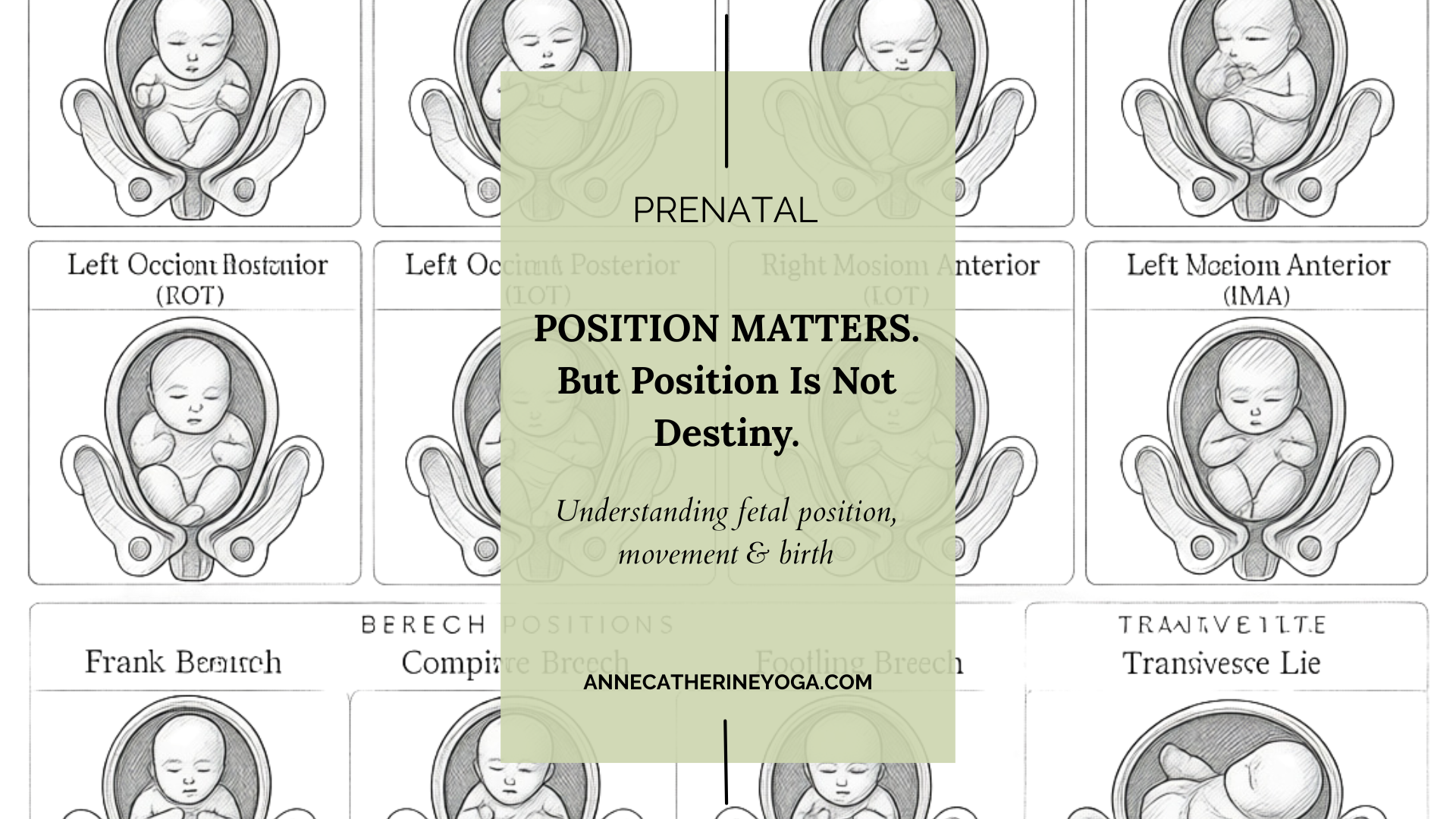
You may have heard that the “best” position for your baby before birth is head down, facing your back.
Maybe your midwife or doctor has told you your baby is posterior. Maybe you've heard terms like OA, OP, breech, or transverse and wondered what they actually mean. Or maybe you've found yourself online looking at exercises, stretches, inversions, birth balls, and programs promising to help get your baby into an “optimal” position.
There is value in movement during pregnancy.
There is value in mobility, strength, breathing, changing positions, and understanding how your own body moves.
But birth preparation isn't simply a matter of getting your body perfectly aligned so your baby can come out.
And your baby isn't a puzzle piece that you need to maneuver into exactly the right place.
Birth is dynamic. Your body is dynamic. Your baby is dynamic.
This is where pregnancy-specific yoga can be incredibly useful—not because yoga guarantees that you can put your baby into the “right” position, but because it can help you support your changing body while developing strength, mobility, body awareness, breath, relaxation, and a whole vocabulary of movement you can take with you into labor.
Why Does Baby's Position Matter?
Your pelvis isn't simply a round opening that your baby drops through.
It has different shapes and dimensions from top to bottom, and your baby makes a series of movements to navigate through it.
Baby tucks the chin.
Baby rotates.
Baby descends.
The shoulders rotate too.
Think less “baby slides down a tube” and more “baby finds a pathway through the pelvis.”
That's why fetal position matters.
When baby's head is tucked and lined up favorably with the space available in the pelvis, it may be easier for baby to descend and rotate. When baby's head is turned or angled differently, baby may need more time, movement, and rotation to find the way through.
Research has found that a baby who remains in a posterior position during birth may be associated with a longer labor and a greater likelihood of assisted vaginal birth or cesarean birth. [1,12]
But there is an important word here:
Remains.
Babies move.
Babies rotate.
One study illustrates just how dynamic fetal position can be. Researchers used ultrasound to identify baby's head position before induction of labor. Of 97 babies who were posterior before induction, only 8% were still posterior at birth. And among the babies who were posterior at birth, most had actually rotated into that position during labor. [13]
Your baby's position today isn't necessarily your baby's position at birth.
That's one reason I am cautious about creating anxiety around baby's position late in pregnancy.
Position matters. But position is not destiny.
The goal isn't to somehow lock your baby into one perfect position before labor begins.
A much more useful goal is to give your body—and your baby—possibilities for movement.
What Does “Optimal Fetal Position” Actually Mean?
Near the end of pregnancy, we generally hope for baby to be head down, which your provider may call cephalic or vertex.
But “head down” doesn't tell us the whole story.
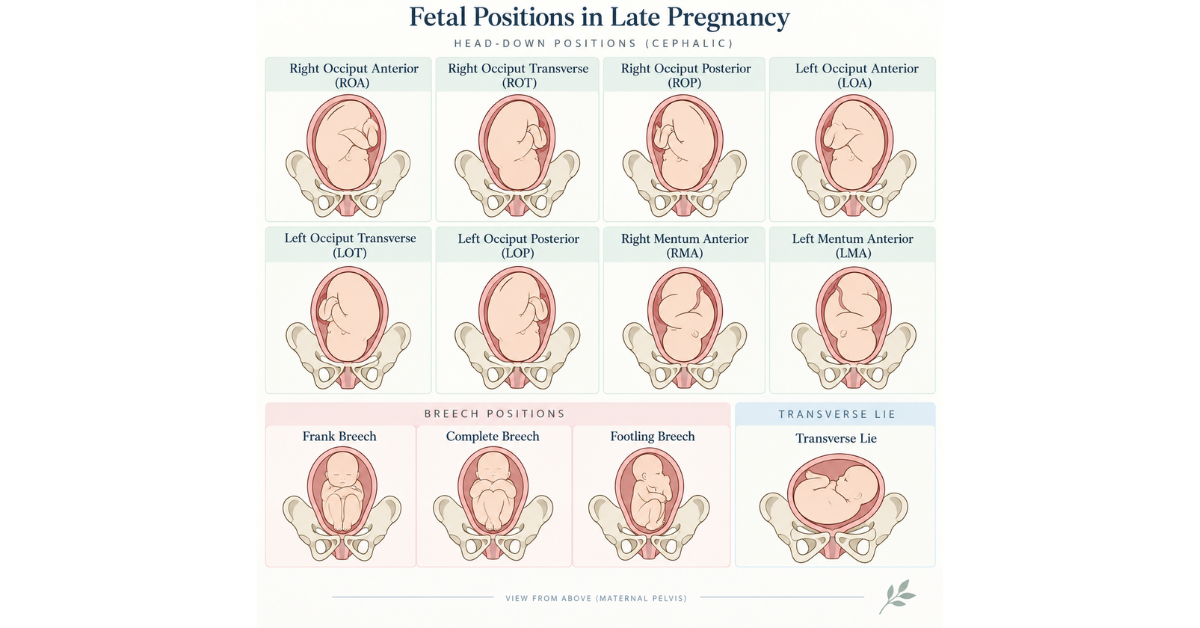
Illustration of common fetal positions in pregnancy including occiput anterior (OA), occiput posterior (OP), occiput transverse (OT), breech and transverse lie.
Occiput Anterior — OA
The position we generally hope for is head down, with baby's back toward the front or side of your belly and baby's face looking toward your spine.
Your provider may call this occiput anterior, or OA.
You may also hear LOA, meaning left occiput anterior, or ROA, meaning right occiput anterior.
In this position, baby's chin can usually tuck toward the chest so the head can move through the pelvis more efficiently.
OA is generally considered a favorable position for vaginal birth.
Occiput Transverse — OT
In an occiput transverse, or OT, position, baby is head down but turned more toward one side.
You may hear LOT, meaning left occiput transverse, or ROT, meaning right occiput transverse.
This isn't automatically a problem.
Babies frequently turn and rotate as they descend during labor.
Occiput Posterior — OP
In an occiput posterior, or OP, position, baby is still head down, but baby's face is looking toward your belly and baby's back is toward your back.
You may hear this called “sunny-side up” or “back-to-back.”
You may also hear LOP, meaning left occiput posterior, or ROP, meaning right occiput posterior.
Many posterior babies rotate during labor.
If baby remains posterior, however, labor can sometimes be longer or more difficult because baby's head may need to make additional movements to navigate through the pelvis. Persistent OP has also been associated with an increased likelihood of assisted vaginal birth or cesarean birth. [1,12]
That doesn't mean you can't give birth vaginally to a posterior baby.
It simply means position is one of many things that can influence how labor unfolds.
Breech
A breech baby has the bottom, feet, or both positioned downward rather than the head.
There are several types of breech positions, including frank, complete, and footling breech.
This is different from a posterior baby. A posterior baby is already head down and may rotate during labor. A breech baby isn't head down.
If your baby remains breech later in pregnancy, your provider may discuss your individual circumstances and options with you, including external cephalic version (ECV), a medical procedure used to try to turn baby head down. [2]
Transverse
A transverse baby is lying sideways across the uterus rather than vertically.
Earlier in pregnancy, babies have plenty of room to move through many different positions. Persistent transverse presentation near the end of pregnancy, however, needs to be evaluated by your maternity care provider.
Why Support Your Body Throughout Pregnancy?
Pregnancy changes much more than the size of your belly.
As your baby grows, your center of gravity changes.
Your ribcage and pelvis adapt.
Your abdominal wall lengthens.
Your pelvic floor experiences increasing pressure and load.
Your breathing changes.
Your hips, spine, legs, and feet continually adjust to carrying a body that may feel different from one week to the next.
And all of this affects everyday life.
How do you get out of bed?
How do you stand and walk?
How do you climb stairs?
How do you get in and out of the car?
How do you pick something up from the floor?
How do you carry an older child?
How do you sit at your desk?
How do you breathe when something feels physically difficult?
These things may seem unrelated to birth.
I don't believe they are.
Birth preparation begins long before labor.
And this is something I learned through my own pregnancies.
What My Two Births Taught Me
When I was pregnant with my first child in 2005, I had already practiced yoga for several years.
But I wasn't doing much yoga during pregnancy, and what I was doing wasn't specifically designed for pregnancy.
Prenatal yoga was far less visible and accessible than it is today. There weren't the abundance of specialized classes, online resources, pregnancy exercise programs, and research-informed resources we now have at our fingertips.
Research on women's health was also in a very different place.
Women had historically been excluded or underrepresented in many areas of medical research, and it wasn't until the early 1990s that NIH policy was strengthened and federal law required women's inclusion in NIH-supported clinical research. [16]
By the time I was pregnant in 2005, women's health research had made important progress—but many of the questions we now ask about pregnancy, pelvic health, exercise, and female physiology were still catching up.
My first pregnancy was also complicated by significant pelvic girdle pain around my pubic symphysis—often called symphysis pubis dysfunction, or SPD.
Some days, I could barely walk.
And then my birth was difficult.
My baby simply wasn't coming down through my pelvis the way we expected. His head was pushing toward my hip rather than being directed toward the pelvic outlet, and eventually intervention was needed to manually help him rotate so that he could descend.
At the time, I didn't understand how any of this might be connected.
I just knew that my pelvis had hurt terribly during pregnancy, and then my baby had difficulty moving through it during birth.
Years later, after studying prenatal yoga, biomechanics, pelvic-floor function, and perinatal corrective exercise, I finally had language for some of what I had experienced.
We can't say that my pubic symphysis dysfunction caused my baby's position. Research doesn't establish that direct connection.
But we do know that pregnancy-related pelvic girdle pain—formerly commonly called SPD—can involve the joints of the pelvis moving unevenly and can significantly affect mobility. Research has also documented measurable changes in pelvic width, tilt, and alignment as pregnancy progresses. [14,15]
And we know that baby's head must engage, rotate, and descend through the available space within the pelvis.
For me, learning about these relationships was an enormous lightbulb moment.
I couldn't go back and prove exactly why my first birth unfolded the way it did, but I finally had a better understanding of why supporting movement and pelvic function throughout pregnancy mattered to me.
What if I had known how to support my body while it was changing, rather than waiting until birth to discover how much movement mattered?
Ten Years Later, I Approached Pregnancy Differently
When I became pregnant again ten years later, I started prenatal yoga during the early weeks.
And I remember thinking something I hear from pregnant moms all the time:
Do I really need prenatal yoga already? I'm not even showing yet.
My answer now?
Yes. Begin when you can.
Assuming movement is appropriate for your pregnancy, you don't need to wait until you have a large pregnant belly before you start learning how to move in your pregnant body.
Starting earlier gives you something incredibly valuable:
Time.
Time to build useful strength.
Time to maintain mobility as your body changes.
Time to adapt to your changing balance.
Time to learn different ways of moving.
Time to notice what feels good.
Time to recognize what doesn't.
And time for movement to become familiar rather than something you suddenly have to figure out during labor.
You Don't Want Labor to Be the First Time You Try the Position
This is something I wish we talked about more.
You don't want the first time you explore a supported squat to be while you're trying to birth your baby.
You don't want the first time you try a lunge to be when a nurse says:
“Put your foot up here and try this.”
You don't want hands and knees, side lying, kneeling, pelvic movement, or intentional breathing to feel like a completely foreign set of instructions while you're having contractions.
You want movement to be familiar.
You want to already know:
This feels good in my hips.
I can breathe here.
I don't like this position.
This helps me release.
This makes me feel stable.
I know another way I can move.
That's very different from memorizing a list of “labor positions.”
It's embodiment.
It's movement literacy.
It's knowing your own body.
And the more you practice throughout pregnancy, the more opportunity your body has to adapt as your baby and belly grow.
My Second Pregnancy and Birth
During my second pregnancy, I did begin to feel a few familiar twinges of pubic symphysis pain.
This time, I recognized them.
Instead of waiting until I could barely walk, I paid attention early.
I worked with targeted strength and release. I noticed which movements and everyday activities aggravated the discomfort and changed how I approached them.
The pain never progressed into anything close to what I experienced during my first pregnancy.
My second birth was dramatically different too.
My baby descended smoothly and was born with only a few mindful, core-aware pushes.
My recovery was much easier.
That's my experience. It isn't proof that prenatal yoga will give someone else the same birth.
I can't tell you that yoga caused my second birth to be easier any more than I can tell you that not practicing prenatal yoga caused my first birth to be difficult.
These were different babies, different pregnancies, and different circumstances separated by ten years.
But those experiences profoundly shaped the way I teach today.
I don't teach prenatal yoga because I believe I can promise you an easy birth.
I teach it because I experienced the difference between entering birth without much pregnancy-specific movement preparation and spending a pregnancy learning, supporting, and adapting with my changing body.
Movement Throughout Pregnancy Is Different From a Last-Minute “Fix”
Here's where some of the research gets interesting.
Researchers have tested whether having pregnant women regularly spend time on hands and knees late in pregnancy would prevent babies from being posterior at birth.
It didn't. [3,4]
That's important information.
But it doesn't mean hands and knees is a useless position.
It means we probably shouldn't think of one position as an exercise that will “turn your baby.”
I look at it differently.
If hands and knees may feel good during pregnancy or become useful during labor, I want you to have practiced it before you're in labor.
The same goes for lunging, squatting, side lying, kneeling, rocking your pelvis, breathing, and changing positions.
You aren't practicing them because one particular pose guarantees the “perfect” baby position.
You're building a vocabulary of movement.
And you're building it gradually as your body changes.
Pregnancy isn't a situation where you suddenly wake up at 36 weeks with a large pregnant belly that now needs to be “fixed.”
Your body has been changing all along.
Your movement practice can change with it.
Movement Variety Matters
Think about how much time many of us spend in the same few positions.
Sitting at a desk.
Sitting in the car.
Relaxing on the sofa.
Standing with our weight shifted into the same hip.
Carrying another child on the same side.
I don't want you to read that list and immediately worry:
Oh no. Have I been sitting wrong? Did I make my baby posterior?
No.
This isn't about creating another list of pregnancy rules.
It's about remembering that bodies benefit from movement variety.
Walk.
Change positions.
Move your hips.
Move your spine.
Get down to the floor and back up again.
Explore kneeling, standing, side lying, hands and knees, and supported squatting.
Rest when you need to rest.
Notice what feels restricted.
Notice what feels comfortable.
You don't need to perform a “perfect” exercise for ten minutes and then forget about your body for the other 23 hours and 50 minutes of the day.
Movement is part of how you live.
But What About Spinning Babies® and Body Ready Method®?
If you've searched for ways to encourage an “optimal fetal position,” you've probably encountered programs such as Spinning Babies® or Body Ready Method®.
Both use movement and biomechanics in different ways to prepare the body for birth, and there can be useful ideas within these approaches.
Spinning Babies®, for example, emphasizes Balance, Gravity, and Movement and includes maternal positions, inversions, soft-tissue techniques, and hands-on bodywork. [8]
Body Ready Method® places more emphasis on functional movement, strength, pelvic mobility, core and pelvic-floor function, pregnancy comfort, and physical preparation for birth.
There is overlap between many of these ideas and what you'll find in prenatal yoga, corrective exercise, physical therapy, and other movement disciplines.
Where I differ is in the bigger picture.
I don't want movement to become another thing you believe you must do correctly in order to have a good birth.
Your pregnant body isn't a problem waiting to be corrected.
And I don't want you to wait until someone tells you at 36 or 38 weeks that your baby isn't in the “right” position before you begin thinking about how you move.
I want you moving, learning, breathing, strengthening, resting, and adapting throughout pregnancy.
The research doesn't support promising that one particular exercise, inversion, or movement sequence will put your baby into the optimal position and give you an easier birth.
That doesn't mean these movements can't be useful.
It means there's an important difference between:
“This movement may help you feel better, move more freely, become comfortable in different positions, and prepare for labor.”
and
“Do this exercise and your baby will move into the right position.”
Those aren't the same claim.
The better question isn't:
What exercise will put my baby in the right position?
It's:
How can I support my body throughout pregnancy so that both my baby and I have possibilities for movement?
Your Body Doesn't Need Someone Else to Constantly “Fix” It
There may absolutely be times when hands-on care from a qualified physical therapist, chiropractor, massage therapist, or other provider is helpful.
I've sought professional help myself.
But I also want you to develop tools that belong to you.
I want you to begin noticing:
How am I standing?
How am I walking?
Do I always shift my weight into one hip?
Can I move my ribcage when I breathe?
What happens when I move my pelvis?
Does this position feel better than that one?
What feels different today than it did a month ago?
You don't have to become an anatomy expert.
You are simply learning to listen to and work with your own body.
The goal isn't perfect alignment.
The goal is having more choices.
The goal is movement literacy and autonomy.
Prenatal Yoga Isn't Just Regular Yoga With a Few Modifications
This distinction matters to me.
Pregnancy-specific yoga should begin with the pregnant body.
In my teaching, I combine prenatal yoga with biomechanics, functional movement, corrective exercise, somatic movement, and pelvic-floor and core education.
We work with hip and pelvic mobility without trying to become as flexible as possible.
We move the spine and ribcage.
We build useful strength and stability.
We explore breathing and pressure management.
We learn about the relationship between the diaphragm, abdominal wall, back, and pelvic floor.
We work with common pregnancy discomforts.
We practice movements that are useful in everyday life.
And yes, we become familiar with positions that may later be useful during labor.
We practice both effort and release.
This isn't taking a regular Vinyasa class and simply removing the poses that are no longer appropriate because you're pregnant.
The practice is designed around pregnancy from the beginning.
Because pregnancy itself deserves support—not simply because we eventually need to get the baby out, but because you are living in your changing body every single day.
Yoga Is More Than Exercise
There is another reason I continue to come back to yoga.
Prenatal yoga has now been studied in clinical research for decades.
Researchers have looked at physical and birth-related outcomes as well as stress, anxiety, depression, pain, quality of life, and emotional well-being. Systematic reviews and meta-analyses have reported promising findings across a number of these areas, while also identifying differences in study design and limitations in the quality of some of the evidence. [9–11]
That nuance matters.
I don't believe we should replace exaggerated promises about fetal positioning with exaggerated promises about yoga.
Yoga can't guarantee a short labor.
It can't guarantee a vaginal birth.
It can't guarantee that you won't experience pelvic pain.
And it can't guarantee that your baby will be in a particular position.
But yoga gives us something broader than an exercise protocol.
Yoga doesn't only ask:
How strong is this muscle?
How mobile is this joint?
How much space can we create in the pelvis?
Yoga also asks:
What do you notice?
How are you breathing?
Where are you holding tension you don't need?
Can you stay present when something feels intense?
Can you adapt?
Can you soften?
Can you rest?
Can you listen to what your body is telling you?
The physical poses—asana—are only one part of yoga.
Breath matters.
Attention matters.
Rest matters.
Self-awareness matters.
The nervous system matters.
Learning when to engage and when to soften matters.
These aren't extras we add after the “real” physical preparation.
They are part of birth preparation.
Birth Isn't a Sporting Event
You've probably heard someone say:
“Birth is a marathon.”
I understand the comparison.
Labor can require stamina. Strength and cardiovascular fitness can absolutely be useful.
But birth isn't actually a sporting event.
You aren't training to push your baby out through physical strength and endurance alone.
Birth involves your hormones.
Your nervous system.
Your pelvic floor.
Your breathing.
Sensation.
Emotion.
Your environment.
Feeling safe.
Feeling supported.
Rest.
And your ability to adapt.
And there is another human being participating in the process.
Your baby moves too.
Baby flexes.
Rotates.
Descends.
Adjusts.
You move and respond.
Birth is a relationship between two moving bodies.
Sometimes effort is needed.
Sometimes the most useful thing you can do is stop adding effort.
Can you release your jaw?
Can you breathe without unnecessarily gripping your abdomen?
Can your pelvic floor respond rather than remain constantly contracted?
Can you change positions when something doesn't feel right?
Can you rest between contractions?
Can you recognize the difference between useful effort and unnecessary tension?
Those are birth skills too.
Your Nervous System Comes With You Into Birth
Preparing for birth isn't only about your muscles and joints.
How you feel matters too.
That doesn't mean you need to remain perfectly calm throughout labor.
You might be loud.
You might shake.
You might cry.
You might feel frightened.
You might feel incredibly powerful.
There isn't a “correct” emotional way to give birth.
And I don't want women hearing that fear will “stop labor” and then becoming afraid of being afraid.
Instead, recognize that your environment and support matter.
Do you feel safe?
Do you have privacy?
Do you understand what's happening?
Do you trust the people around you?
Can you move?
Are people listening to you?
Can you participate in decisions about your body?
Do you have someone supporting you?
The World Health Organization recognizes respectful care, good communication, companionship, mobility, and choice of birth position as important components of a positive childbirth experience. [5,6]
We can't completely separate the pelvic floor from the nervous system coordinating it.
The person living inside the pelvis matters too.
Who Will Support You?
This is another part of birth preparation that sometimes gets overlooked.
We spend a lot of time asking:
Is my body ready?
But also ask:
Who helps me feel safe?
Who understands what matters to me?
Who can help protect my space?
Who can remind me that I have options?
What happens if our original plan changes?
Research on continuous labor support has found benefits that may include a greater likelihood of spontaneous vaginal birth, shorter labor, fewer cesarean and instrumental births, and fewer negative feelings about childbirth, although the strength of evidence varies by outcome. [7]
Who surrounds you matters too.
You Can Prepare Without Trying to Control Birth
Perhaps one of the most important lessons yoga has taught me is this:
We can prepare. We cannot control.
You can practice prenatal yoga throughout pregnancy and still have a posterior baby.
You can have wonderful hip mobility and have a breech baby.
You can be physically strong and experience a long labor.
You can do every “right” exercise and ultimately need a cesarean birth.
None of that means you failed.
Birth preparation should never become another list of things women can blame themselves for when birth doesn't unfold according to plan.
Instead, preparation can give you resources.
More ways to move.
More awareness of your body.
More familiarity with your breath.
More ways to find comfort.
More understanding of your core and pelvic floor.
More confidence trying different positions.
More ability to communicate what you need.
And more capacity to adapt when something unexpected happens.
That is what I want you to take into birth.
Prepare for Pregnancy, Birth—and What Comes After
Ultimately, I don't want to give you another protocol you believe you have to perform perfectly.
I want to give you tools you can carry with you.
And those tools don't disappear after your baby is born.
Breathing.
Pressure management.
Functional movement.
Body awareness.
Adaptability.
Rest.
Knowing when to ask for support.
You will use those skills in postpartum too.
Pregnancy isn't simply preparation for getting a baby out.
It's the beginning of a profound transition into life with this baby.
And you deserve support throughout that transition too.
Continue Preparing for Pregnancy, Birth & Postpartum
Pregnancy Comfort Toolkit
My Pregnancy Comfort Toolkit offers practical movement, positioning, sleep, breathing, and everyday strategies to help you feel more comfortable in your changing body.
Rather than waiting until discomfort becomes overwhelming, you can begin building a toolkit for understanding and supporting your body throughout pregnancy.
Explore the Pregnancy Comfort Toolkit → HERE
Postpartum Planning Workbook
Preparing for birth also means thinking about what happens after everyone goes home.
My Postpartum Planning Workbook helps you prepare for the practical realities of the early weeks: meals, household responsibilities, feeding support, rest, older children, pets, visitors, recovery, your support team, and what happens when Plan A doesn't work.
Get the Postpartum Planning Workbook → HERE
Women's Health + Prenatal Yoga
If you're local to Boulder County, my Women's Health + Prenatal Yoga classes combine pregnancy-specific yoga with functional movement, biomechanics, breath, pelvic-floor and core education, and practical preparation for pregnancy, birth, and recovery.
No previous yoga experience is needed.
And you don't need to wait until you're showing.
The earlier you begin learning your pregnant body, the more time you have to practice adapting with it.
Learn More About Prenatal Yoga → HERE
Private Prenatal Sessions
For individualized support, I also offer private prenatal yoga and functional movement sessions.
Rather than fitting your pregnancy into a generic exercise program, we can look at how your body moves, what you're experiencing now, and what may help you feel more comfortable and capable throughout pregnancy.
Learn More About Private Sessions → HERE
Medical Disclaimer
This article is provided for educational and informational purposes only and is not medical advice, diagnosis, or treatment. It isn't intended to replace individualized care from your obstetrician, midwife, physical therapist, or other qualified healthcare professional.
Fetal presentation and position should be assessed by an appropriately qualified maternity care provider. Breech or transverse presentation, concerns about fetal movement, pain, bleeding, contractions, rupture of membranes, pregnancy complications, or questions about whether a particular movement or yoga posture is appropriate for you should be discussed with your healthcare provider.
Do not attempt to manually turn your baby or undertake specialized fetal-positioning techniques, inversions, or exercises without determining whether they are appropriate for your individual pregnancy.
Every pregnancy and birth is different. Nothing in this article guarantees a particular fetal position, labor experience, mode of birth, or outcome.
References
1. American College of Obstetricians and Gynecologists. First and Second Stage Labor Management. Clinical Practice Guideline No. 8. Obstetrics & Gynecology. 2024.
2. American College of Obstetricians and Gynecologists. If Your Baby Is Breech. ACOG Patient FAQ.
3. Kariminia A, Chamberlain ME, Keogh J, Shea A. Randomised controlled trial of effect of hands and knees posturing on incidence of occiput posterior position at birth. BMJ. 2004;328:490. doi:10.1136/bmj.37942.594456.44.
4. Hunter S, Hofmeyr GJ, Kulier R. Hands and knees posture in late pregnancy or labour for fetal malposition (lateral or posterior). Cochrane Database of Systematic Reviews. 2007;(4):CD001063. doi:10.1002/14651858.CD001063.pub3.
5. World Health Organization. WHO Recommendations: Intrapartum Care for a Positive Childbirth Experience. Geneva: World Health Organization; 2018.
6. World Health Organization. Making Childbirth a Positive Experience. 2018.
7. Bohren MA, Hofmeyr GJ, Sakala C, Fukuzawa RK, Cuthbert A. Continuous support for women during childbirth. Cochrane Database of Systematic Reviews. 2017;(7):CD003766. doi:10.1002/14651858.CD003766.pub6.
8. Spinning Babies®. What Is Spinning Babies? Official educational resources describing the Balance, Gravity and Movement framework and maternal positioning techniques.
9. Curtis K, Weinrib A, Katz J. Systematic review of yoga for pregnant women: current status and future directions. Evidence-Based Complementary and Alternative Medicine. 2012;2012:715942. doi:10.1155/2012/715942.
10. Kawanishi Y, Hanley SJB, Tabata K, et al. Effects of prenatal yoga: a systematic review of randomized controlled trials. Nihon Koshu Eisei Zasshi. 2015;62(5):221–231. doi:10.11236/jph.62.5_221.
11. Corrigan L, Moran P, McGrath N, Eustace-Cook J, Daly D. The characteristics and effectiveness of pregnancy yoga interventions: a systematic review and meta-analysis. BMC Pregnancy and Childbirth. 2022;22:250. doi:10.1186/s12884-022-04474-9.
12. Ponkey SE, Cohen AP, Heffner LJ, Lieberman E. Persistent fetal occiput posterior position: obstetric outcomes. Obstetrics & Gynecology. 2003;101(5 Pt 1):915–920. doi:10.1016/S0029-7844(03)00068-1.
13. Peregrine E, O'Brien P, Jauniaux E. Impact on delivery outcome of ultrasonographic fetal head position prior to induction of labor. Obstetrics & Gynecology. 2007;109(3):618–625. doi:10.1097/01.AOG.0000255972.48257.83.
14. Royal College of Obstetricians and Gynaecologists. Pelvic Girdle Pain and Pregnancy. Patient information.
15. Morino S, Ishihara M, Umezaki F, Hatanaka H, Yamashita M, Aoyama T. Pelvic alignment changes during the perinatal period. PLoS ONE. 2019;14(10):e0223776. doi:10.1371/journal.pone.0223776.
16. National Institutes of Health. NIH Guidelines on the Inclusion of Women and Minorities as Subjects in Clinical Research. Implemented pursuant to the NIH Revitalization Act of 1993.
