
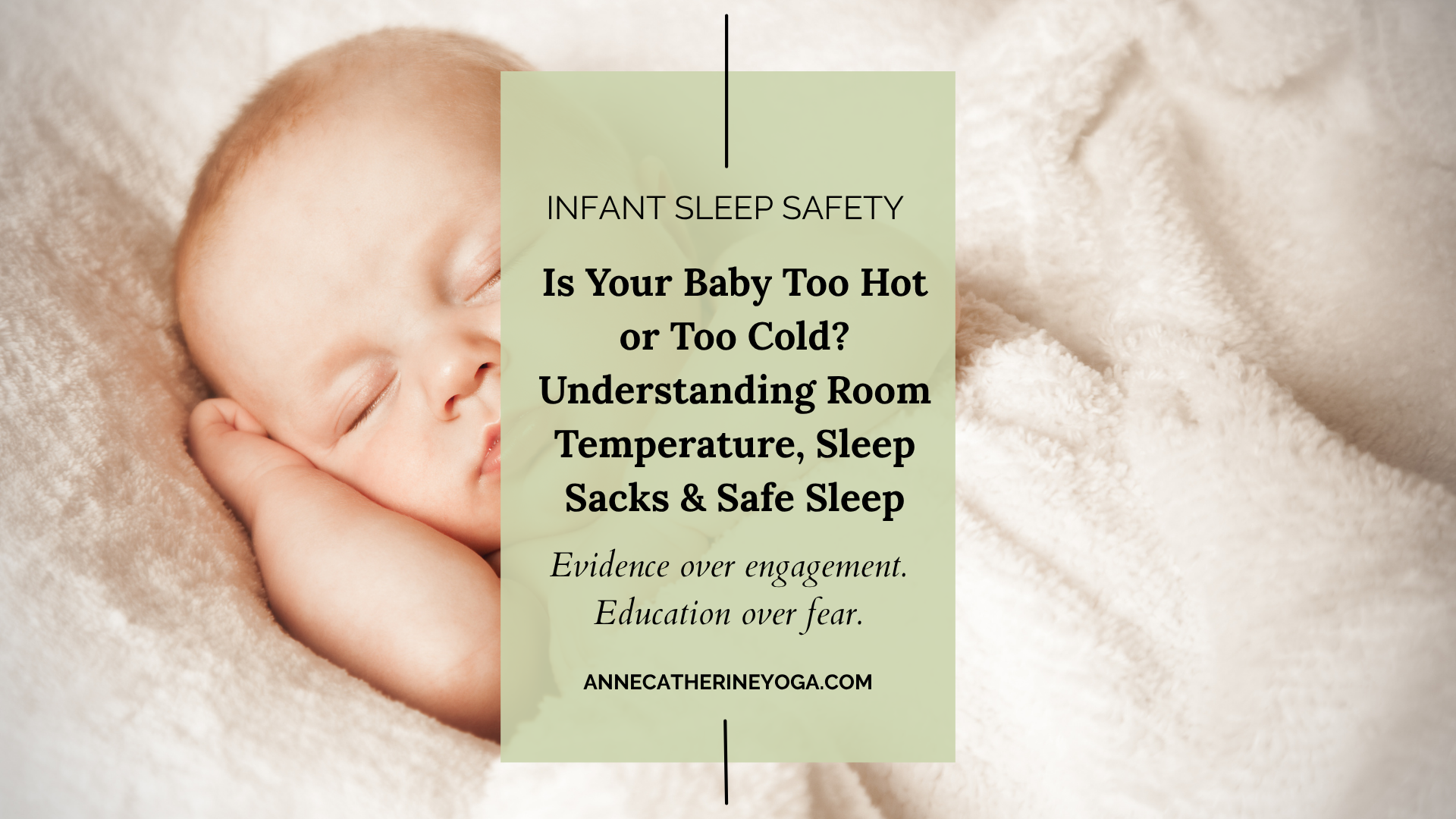
Why keeping babies comfortable matters more than keeping them cool—and why we need to fact-check parenting advice on social media.
As we head into the colder months, I want to talk about something that comes up frequently in conversations with new parents: how warm should we keep our babies?
Recently, I came across a Facebook post making some pretty dramatic claims about infant temperature regulation. It started with the statement, "A hot baby is not a healthy baby. A cool baby is a safe baby."
It went on to suggest that babies who are cold will cry to let us know, while babies who are overheated will become quiet.
There were some accurate recommendations mixed into the post, including the importance of avoiding overheating during sleep. But there was also some concerning misinformation.
And this is exactly why I encourage parents to fact-check what they read on social media, especially when it comes to their children's health and safety.
The Problem With Shock-and-Awe Parenting Advice
Social media can be a wonderful place to connect with other parents, share experiences, and discover helpful resources. But it is not always a reliable source of medical or parenting information.
Unfortunately, some influencers exaggerate, oversimplify, or misrepresent information to capture attention.
A dramatic statement gets people to stop scrolling. A frightening claim encourages comments. A controversial opinion gets shared.
And all of that engagement can translate into more visibility and, sometimes, more revenue for the person creating the content.
That doesn't mean every influencer is intentionally misleading people. But popularity is not the same thing as credibility, and a viral post is not necessarily an accurate one.
When you see a post making sweeping statements about infant safety, especially one that tells you everything you've been taught is wrong, I encourage you to look a little deeper.
Who is making the claim? What are their qualifications? Are they citing actual research or simply saying "science says"? And does the information agree with recommendations from reputable medical organizations?
A little healthy skepticism can go a long way.
Babies Need to Be Warm Enough, Not Too Hot or Too Cold
One of the most misleading claims in the post was that cold isn't the enemy—heat is.
The reality is that both overheating and excessive cooling can be dangerous for infants.
Newborns are still developing their ability to regulate body temperature. They lose heat more readily than adults, and their bodies respond differently to changes in their environment.
This is particularly important for premature babies, low-birth-weight infants, and newborns in their first days and weeks of life.
Our goal isn't to keep babies cool.
Our goal is to help them maintain a comfortable, healthy body temperature.
The World Health Organization emphasizes the importance of thermal protection for newborns, including keeping babies appropriately warm and preventing hypothermia.
Do Cold Babies Cry and Hot Babies Go Silent?
No. And this was the claim that concerned me the most.
The post repeatedly stated that a cold baby will cry, while an overheated baby will become quiet.
It sounds simple and memorable, but it is not a reliable way to assess a baby's temperature.
A baby who is cold may cry or become unsettled. But a baby experiencing significant cold stress may also become unusually quiet, less active, feed poorly, or become lethargic.
Similarly, an overheated baby may become flushed, sweaty, irritable, or lethargic.
Both overheating and hypothermia can affect an infant's alertness and behavior.
We cannot assume that a crying baby is cold or that a quiet baby is overheated.
And we certainly shouldn't teach parents to rely on those signals alone.
How Babies Actually Stay Warm
Here's something I find fascinating about infant physiology.
Newborns have a special type of fat called brown adipose tissue, commonly known as brown fat.
Unlike adults, who rely heavily on shivering to generate additional body heat, newborns primarily use a process called non-shivering thermogenesis.
Brown fat helps generate heat when an infant is exposed to cooler temperatures.
But this process requires energy and oxygen. It isn't an unlimited heating system, and it doesn't mean babies can safely tolerate prolonged cold exposure.
Babies also have mechanisms for releasing heat, including sweating and changes in blood flow to the skin. However, these systems are still developing and are less effective than those of older children and adults.
This is why infants need our help maintaining an appropriate temperature.
Overheating and SIDS: What the Research Actually Says
There is an important truth in the original Facebook post.
Overheating during sleep is associated with an increased risk of sudden infant death syndrome (SIDS).
The American Academy of Pediatrics recommends avoiding excessive clothing and bedding, keeping an infant's head uncovered during sleep, and watching for signs of overheating.
But this doesn't mean we should intentionally keep babies cold.
It means we should avoid excessive bundling and create a safe, comfortable sleep environment.
The AAP also does not establish a universal room-temperature requirement of 68–72°F for preventing SIDS, despite what many social media posts claim.
Instead, its guidance focuses on appropriate clothing, safe bedding, and monitoring for overheating.
What Temperature Should Your Baby's Room Be?
One of the simplest ways to support healthy infant sleep is to pay attention to the temperature of the room where your baby sleeps.
I recommend keeping a small digital thermometer in your baby's sleeping area. You may be surprised to discover that the temperature in your bedroom or nursery is quite different from what your thermostat says.
The American Academy of Pediatrics does not prescribe one specific room temperature for preventing SIDS. However, the UK's National Health Service and The Lullaby Trust recommend a cooler range of 61–68°F (16–20°C), with appropriate sleep clothing and bedding.
American Academy of Pediatrics+2
For families accustomed to warmer indoor temperatures, 68–72°F can be a practical starting point, provided babies are dressed lightly enough to avoid overheating. This is not a guarantee of safety or a reason to heat a room to that range.
The most important consideration is how your baby is dressed for the actual room temperature, not the season or thermostat setting.
Understanding TOG Ratings
When shopping for sleep sacks, you'll often see a number followed by the letters TOG.
TOG is a measurement of thermal insulation. The higher the number, the warmer the sleep sack.
Here's a general guide based on NHS sleep-bag guidance.
Room Temperature & Recommended Sleep Sack Warmth
61–68°F (16–20°C): 2.5 TOG — Warmer sleep sack for cooler rooms.
69–73°F (20–23°C): 1.0 TOG — Lightweight sleep sack for moderate room temperatures.
74–80°F (23–27°C): 0.2–0.5 TOG — Very lightweight sleep sack for warmer rooms, depending on the manufacturer.
Above 80°F (27°C): Minimal clothing — Prioritize cooling the room and preventing overheating.
These are approximate guidelines, not rigid rules. Always follow the manufacturer's clothing recommendations, account for pajamas or other layers underneath, and check your baby for signs of overheating. TOG ratings describe insulation, not a guaranteed safe temperature.
Dressing Your Baby for Winter, Spring, and Summer
Winter: Warmth Without Overbundling
Colorado winters can be cold, but that doesn't necessarily mean your baby's bedroom is cold.
If your home stays comfortably heated overnight, your baby may not need fleece pajamas or a particularly heavy sleep sack.
For cooler rooms, consider cotton footed pajamas paired with an appropriately rated sleep sack. Avoid stacking multiple thick layers.
Spring and Fall: Be Prepared for Fluctuating Temperatures
These transitional seasons can be especially tricky. One evening the bedroom may be 72°F, while the following night it drops several degrees.
This is when having both a lightweight and a warmer sleep sack can be particularly helpful.
Choose clothing based on the temperature of the room at bedtime and how it changes overnight.
Summer: Lightweight and Breathable
During warmer months, a lightweight cotton bodysuit or pajamas may be all your baby needs.
For particularly warm rooms, a very lightweight sleep sack—or simply a diaper or bodysuit—may be appropriate.
Keep the room ventilated when possible, use curtains or shades to reduce daytime heat, and avoid placing the crib in direct sunlight or near a heat source.
One more important safety reminder: Choose a properly fitted sleep sack with an uncovered head, unrestricted arms once rolling begins, and no added weights. Stop swaddling as soon as your baby shows signs of attempting to roll.
Recommended Products for Baby's Sleep Environment
Disclosure: Some product links may be affiliate links. If you purchase through one of my links, I may receive a small commission at no additional cost to you. These commissions help support the educational resources I create for families.
My Recommended Room Thermometers
One of the simplest things you can do to help maintain a comfortable sleep environment for your baby is to keep a thermometer in the room where they sleep.
I recommend this because the temperature in your baby's sleeping area may be different from the temperature displayed on your home's thermostat.
You don't need expensive equipment. A simple digital thermometer is perfectly adequate. But for parents who enjoy technology and appreciate being able to check conditions remotely, there are some wonderful options.
Here are two recommendations depending on your preferences and budget.
For Simplicity and Affordability: ThermoPro TP50
ThermoPro TP50 Digital Indoor Thermometer and Hygrometer
This is a wonderful, budget-friendly option for parents who want something simple and reliable.
It displays the room temperature and relative humidity, with no complicated setup, Wi-Fi connection, or additional apps.
Place it somewhere in your baby's sleeping area, safely out of reach, and you can easily check the room conditions whenever needed.
For most families, this is really all you need.
For the Tech-Savvy Parent: GoveeLife Smart Thermometer and Hygrometer
GoveeLife Smart Thermometer and Hygrometer — 3-Pack with Gateway
If you're someone who appreciates a little more technology and the peace of mind that comes with being able to monitor your baby's environment, this may be a great option.
This system includes multiple temperature and humidity sensors with a gateway for connected monitoring.
Depending on the model and app configuration, smart monitoring can allow you to view temperature readings, follow changes over time, and receive notifications when conditions move outside your preferred range.
I especially like the idea of being able to monitor different rooms, since temperatures can vary throughout the house.
Of course, no thermometer or smart device replaces checking on your baby and paying attention to their comfort.
Remember: The goal isn't to maintain one perfect number on a thermometer. It's to create a comfortable sleeping environment and dress your baby appropriately for the actual room temperature.
My Recommended Sleep Sacks
ergoPouch Sleep Sack 2.5 TOG Willow 8-24M
Winter — ergoPouch Sleep Sack 2.5 TOG Willow 8-24M
Approx. $64.95
A warmer, 2.5 TOG wearable blanket for cooler bedrooms. A useful choice when the actual sleeping environment calls for additional insulation, rather than simply because it's winter.
Spring and fall — HALO Baby Micro-Fleece 1.0 TOG Sleepsack Sleeveless Wearable
Approx. $34.99
A 1.0 TOG wearable blanket that can be useful for moderately warm rooms and changing seasonal conditions. Adjust the clothing underneath according to the room temperature.
Wearable Blanket 100% Cotton TOG 0.5
Summer — Wearable Blanket 100% Cotton TOG 0.5
Approx. $34.99
A lightweight, 100% cotton 0.5 TOG sleep sack for warmer rooms. Its sleeveless design makes it a practical alternative to loose blankets
ergoPouch Sleep Sack 0.2 TOG Sage 3-12M
Hot summer nights — ergoPouch Sleep Sack 0.2 TOG Sage 3-12M
Approx. $39.95
An extra-light 0.2 TOG option for warmer sleeping environments. This particular model is designed for arms-out sleepers, so check the baby's age, measurements, and manufacturer's sizing guidance.
A Note About Sleep Clothing
I generally recommend starting with simple, breathable cotton clothing and adjusting according to your baby's needs.
For example, a cotton footed sleeper can be useful in cooler weather, while a short-sleeved bodysuit may be sufficient in a warmer room.
Remember that the clothing underneath a sleep sack contributes to the overall insulation. You don't need a heavy sleep sack and heavy fleece pajamas simply because it's winter.
A sleep sack should fit properly around the neck and shoulders so your baby cannot slip inside it, while allowing room for healthy hip movement. Always choose the appropriate size rather than buying one to grow into.
What About Hats, Blankets, and Sleep Sacks?
For indoor sleep, the AAP recommends:
Dressing babies in no more than one additional layer compared with what a comfortable adult would wear in the same environment.
Avoiding hats indoors after the immediate newborn period, unless medically necessary.
Keeping loose blankets, quilts, comforters, and other soft bedding out of the sleep space.
Using an appropriately sized, non-weighted wearable blanket or sleep sack when additional warmth is needed.
Always placing babies on their backs to sleep on a firm, flat surface.
And remember, a sleep sack is already a layer of insulation. Consider the fabric and warmth of the sleep sack along with the clothing underneath.
How Can You Tell if Your Baby Is Comfortable?
One of the more accurate recommendations in the original post was to check your baby's chest or the back of their neck rather than relying on the temperature of their hands and feet.
Babies often have cooler hands and feet because of differences in circulation and temperature regulation.
Cool fingers or toes don't automatically mean your baby needs another layer.
Instead, gently feel your baby's chest or the back of their neck.
If their skin feels comfortably warm and dry, that's generally reassuring.
If they feel unusually hot, sweaty, or flushed, consider whether they're wearing too many layers or whether the room is too warm.
If their chest or back feels unusually cool, or they seem unwell, don't simply assume they will cry if they need more warmth.
Touch is a helpful observation, but it is not a substitute for checking body temperature with a thermometer when illness or abnormal temperature is suspected.
A baby younger than three months with a temperature of 100.4°F (38°C) or higher needs immediate medical evaluation. A baby who is unusually lethargic, difficult to wake, breathing abnormally, or showing signs of significant cold stress also needs prompt medical attention.
What About Winter Weather?
Living in Colorado, we know that outdoor temperatures can change dramatically throughout the day.
The clothing your baby needs for a winter walk is not necessarily what they need while sleeping indoors.
A baby bundled for a stroller walk may need layers removed when you return home.
And one important reminder: bulky winter coats and snowsuits should not be worn underneath car seat harness straps.
Bulky clothing can compress during a crash, leaving the harness too loose to properly protect your child.
Instead, dress your baby in thin, warm layers, secure the harness snugly, and place a blanket or coat over the straps for additional warmth when needed.
A Final Thought: Please Fact-Check What You Share
As parents, we all want to do what's best for our children.
And when we see a post claiming to reveal something important about infant safety, our instinct may be to share it with other parents.
I understand that. We want to help one another.
But I encourage you to take a moment before hitting that share button.
Is the information accurate? Is it supported by reliable evidence? Could someone misunderstand it in a way that puts their child at risk?
Sometimes the most dangerous misinformation isn't entirely false. It's a mixture of accurate information, exaggerated claims, and misleading conclusions.
That combination can make a post sound especially convincing.
And unfortunately, the social media algorithms often reward dramatic content over thoughtful, nuanced education.
We don't need more fear-based parenting advice.
We need accessible, trustworthy information that helps parents understand their babies and make informed decisions.
So as we head into the colder months, remember:
A baby who is too hot isn't safe. A baby who is too cold isn't safe either.
Our goal is not to keep babies cool. It's to help them maintain a healthy body temperature.
And when it comes to infant safety, let's choose evidence over engagement, education over fear, and thoughtful sharing over viral misinformation.
References and Further Reading
American Academy of Pediatrics (2022). Moon, R. Y., Carlin, R. F., & Hand, I. Sleep-Related Infant Deaths: Updated 2022 Recommendations for Reducing Infant Deaths in the Sleep Environment. Pediatrics, 150(1), e2022057990. Read the AAP recommendations.
American Academy of Pediatrics — HealthyChildren.org. How to Keep Your Sleeping Baby Safe: AAP Policy Explained. Read the parent-friendly guidance.
National Institutes of Health — Safe to Sleep. Ways to Reduce Baby's Risk of SIDS and Other Sleep-Related Causes of Infant Death. Read the safe sleep recommendations.
World Health Organization (1997). Thermal Protection of the Newborn: A Practical Guide. WHO/RHT/MSM/97.2. Read the WHO publication.
National Highway Traffic Safety Administration. Winter Driving Tips. Includes guidance on bulky clothing and child car seat harness safety. Visit NHTSA.
Educational disclaimer: This article is intended for general education and is not a substitute for individualized medical advice. Consult your pediatric healthcare provider with questions about your baby's temperature, health, or safe sleep needs.
A Note About Affiliate Links: I occasionally share products that I believe may be helpful to families. Some links in this article are affiliate links, which means I may earn a small commission if you make a purchase, at no additional cost to you. These commissions help support my work and allow me to continue creating educational resources for women and families. My recommendations are guided by safety, practicality, and informed choices—not commissions.
© 2026 Anne Catherine Yoga LLC. All rights reserved.
