
Why Does My Back Hurt During Pregnancy? Rethinking Pregnancy Posture, Low Back Pain & Hip Pain
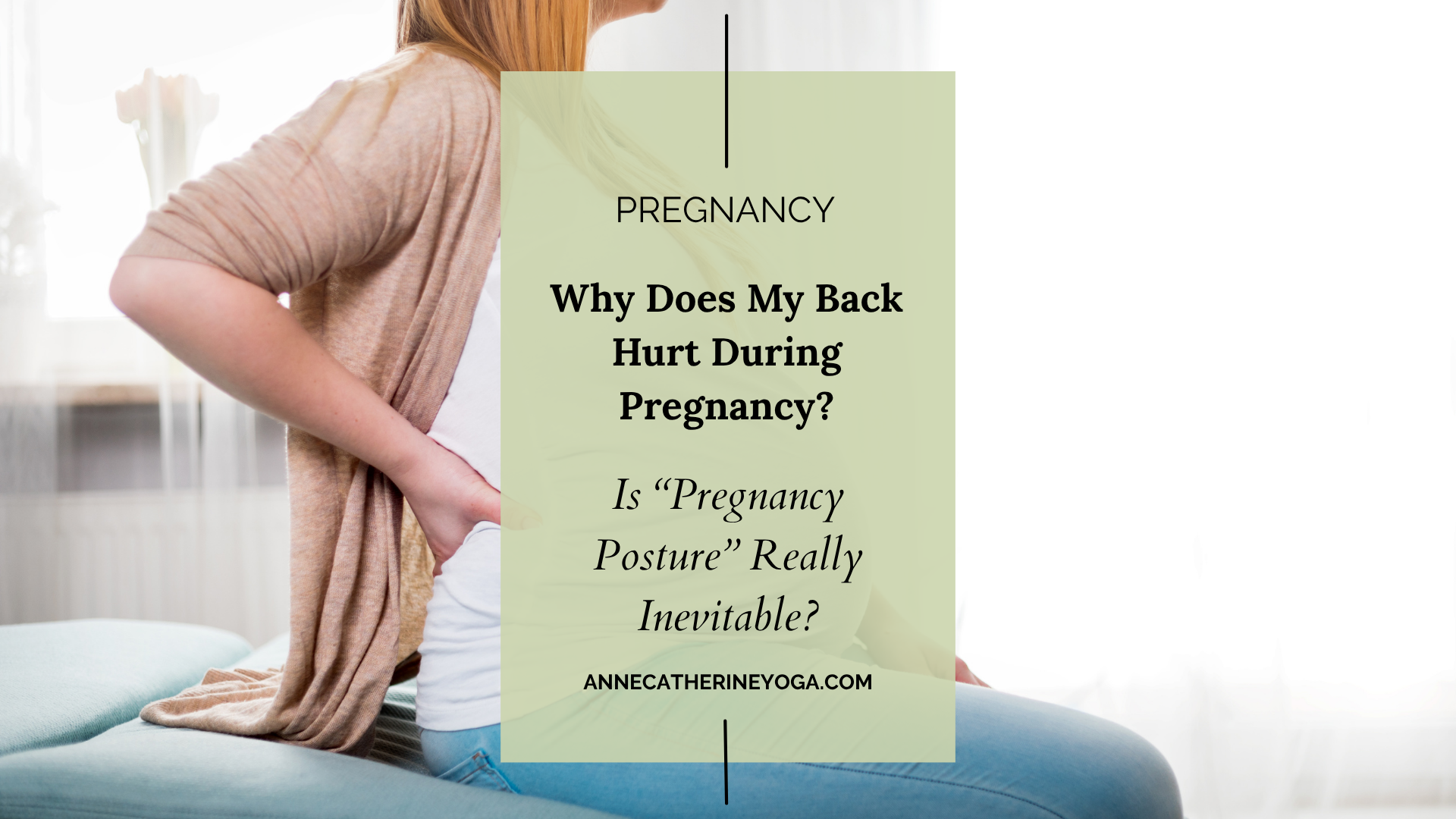
Is pregnancy posture inevitable? Does your growing belly really have to change the way you stand? And is back or hip pain simply part of being pregnant? Let's look at what biomechanics and research tell us.
“My low back hurts, but I guess that's just pregnancy.”
“My hips have started hurting when I walk.”
“My chiropractor told me every pregnant woman develops pregnancy posture because the belly shifts your center of gravity.”
I hear versions of these statements all the time.
And there is some truth underneath them. Pregnancy really does change the way your body manages gravity and load.
Your belly grows. Your weight distribution changes. Your abdominal wall lengthens. Your pelvis, hips, spine, and muscles are responding to a body that can be noticeably different from one week to the next.
But here's the part I want more pregnant women to know:
Your body has to adapt to pregnancy. It does not have to adopt one specific “pregnancy posture.”
And pain shouldn't automatically be dismissed as something you simply have to put up with until your baby arrives.
What Is “Pregnancy Posture”?
Picture the stereotypical pregnant stance:
Your growing belly moves forward.
Your pelvis shifts forward with it.
Your upper body leans backward to counterbalance the weight.
Your rib cage may lift or thrust forward.
Your lower back may develop a more pronounced curve.
Your knees may habitually lock backward.
Your weight may shift toward the front of your feet.
You may also find yourself essentially “hanging” into your hips rather than actively using the muscles of your legs and hips to support yourself.
It makes intuitive sense.
Place a growing load on the front of the body, and the body finds a way to keep you balanced.
For years, these changes have often been described as an inevitable consequence of pregnancy.
Baby grows → center of gravity shifts → lumbar curve increases → pregnancy posture.
You may still hear this explanation from doctors, chiropractors, fitness professionals, and prenatal yoga teachers.
But there's an important difference between a common compensation and a biomechanical requirement.
Why Are We Still Being Told Pregnancy Posture Is Inevitable?
For decades, healthcare education has described pregnancy-related postural changes as a predictable response to the growing uterus.
And this explanation hasn't disappeared.
What Has Traditional Medical Education Taught?
The American College of Obstetricians and Gynecologists (ACOG) describes how pregnancy shifts the body's center of gravity and can increase the curve of the lower back, known as lumbar lordosis.
Its guidance also recognizes that pregnancy-related changes in posture, joint loading, and abdominal muscle function can contribute to back pain.
Read ACOG's guidance on back pain during pregnancy
These explanations are not necessarily wrong.
Pregnancy does change the distribution of weight through the body, and many women do experience changes in spinal curvature.
But describing a commonly observed change is not the same as demonstrating that every pregnant woman must develop it.
What About Chiropractic Care?
A 2008 article published in the Journal of Chiropractic Medicine, titled Pregnancy and Chiropractic: A Narrative Review of the Literature, describes how the growing fetus changes weight distribution and how the body may compensate through increased lumbar curvature and changes in pelvic position.
The article also discusses how low-back pain has historically been treated as an expected complication of pregnancy.
This is a useful example of how pregnancy biomechanics has traditionally been explained.
But it raises an important question:
Are these changes unavoidable, or are they some of the ways the body adapts to pregnancy?
That's a very important distinction.
What Does Newer Research Tell Us?
When researchers actually measure pregnant bodies, they don't find every woman adopting exactly the same posture.
A systematic review titled The Biomechanics of Pregnancy examined 50 research papers investigating pregnancy-related changes in posture, walking, balance, and movement.
Researchers found that changes in spinal curvature were not consistent across studies.
Some studies reported increased lumbar curvature, while others found little or no change.
Importantly, the review also reported that pregnancy-related back pain did not show a significant correlation with changes in spinal curvature in the research examined.
A more recent systematic scoping review, published in 2025, reinforced the importance of individual variation.
Researchers found differences in how pregnant women adapt to changing body mass, including variations in pelvic orientation, spinal curvature, and walking patterns.
In other words, there is no single pregnancy posture that every woman's body is required to adopt.
And having a more pronounced lumbar curve doesn't automatically explain why someone experiences back pain.
This doesn't mean posture is irrelevant.
It means the relationship between posture, movement, and pain is more complex than we've often been led to believe.
Does This Mean My Doctor, Midwife, or Chiropractor Is Wrong?
Not necessarily.
And I want to be very clear about something: I'm not discrediting doctors, midwives, chiropractors, or other healthcare professionals.
I have tremendous respect for practitioners who dedicate their careers to helping people feel better and function well.
But healthcare education, like all education, evolves.
An OB-GYN, midwife, chiropractor, physical therapist, or yoga teacher may have learned a particular explanation during their initial training. At the time, that explanation may have represented the prevailing understanding of pregnancy biomechanics.
Years later, newer research may provide a more nuanced picture.
That doesn't automatically mean the practitioner is poorly trained or providing bad care. It may simply mean that an explanation they learned years ago has not yet been updated to reflect newer evidence.
And many practitioners are already doing exactly what we should hope for: continuing their education, questioning established assumptions, and integrating new research into their work.
I believe the best healthcare comes from practitioners who are willing to keep learning.
Chiropractic Care Can Be a Wonderful Part of Whole-Body Wellness
I want to speak specifically about chiropractic care because I personally benefit greatly from it.
My own chiropractor takes a comprehensive approach that goes beyond spinal adjustments. Our sessions may include soft-tissue work, massage, and other manual techniques to address muscle tension and movement restrictions.
I appreciate care that considers how the body functions as a whole rather than focusing exclusively on the location of discomfort.
And I know many chiropractors practice this way.
They consider the relationships between joints, muscles, connective tissues, movement habits, and daily activities. They may collaborate with physical therapists, massage therapists, exercise professionals, and other healthcare providers when appropriate.
That's the kind of integrated, patient-centered care I value.
An adjustment can be a useful tool. So can massage, corrective exercise, physical therapy, and movement education.
None of these approaches needs to be the entire solution.
Are We Treating the Symptom or Helping Address What's Contributing to It?
Here's where I think an important distinction needs to be made.
Imagine a pregnant woman comes in with recurring low-back or hip pain.
She receives an adjustment, experiences some relief, and returns home.
A week later, the discomfort returns.
She schedules another appointment, receives another adjustment, and feels better again.
There may be legitimate reasons for repeated care, especially during pregnancy when the body is continually changing.
But I think we should also be asking:
What happens during the other 167 hours of her week?
How is she standing?
How is she walking?
How is she getting in and out of her car?
How is she carrying her toddler?
How is she sleeping?
How is she managing the changing load of her growing belly?
Are there movement patterns, strength limitations, or daily habits that might be contributing to her discomfort?
And if so, are we helping her understand and address them?
Manual treatment may provide relief without necessarily changing the circumstances that contribute to recurring symptoms.
That's not a criticism of manual therapy. It's a recognition that hands-on treatment and movement education can serve different, complementary purposes.
When Treatment Becomes the Entire Solution
This is where I think both healthcare practitioners and patients benefit from asking some thoughtful questions.
Is the goal to help someone become more capable of managing their own body?
Or is the patient being led to believe that their body continually needs someone else to put it back into alignment?
Sometimes healthcare marketing presents the practitioner or treatment as the solution, rather than one part of a broader plan for health and function.
That can unintentionally encourage dependence on repeated appointments instead of helping people develop the knowledge and skills to support themselves.
And in some cases, a model built around recurring visits may create a financial incentive to keep treatment going, even when additional strategies or referrals would better serve the patient.
That doesn't mean every practitioner recommending ongoing care is motivated by money. Many patients genuinely benefit from maintenance or recurring treatment.
But a patient's long-term well-being should always come before the business model of any healthcare practice.
I think that's a standard worth holding across all healthcare professions, including my own work as a yoga teacher and movement educator.
The Best Practitioners Help You Beyond the Treatment Room
To me, truly holistic care isn't necessarily about how many different treatments a practitioner offers.
It's about looking at the whole person.
It's recognizing that a woman with pregnancy-related back pain is not simply a spine that needs adjusting.
She's a person whose body is changing rapidly.
She has daily responsibilities, movement habits, physical demands, stress, sleep needs, and perhaps other children to care for.
She may benefit from hands-on treatment.
She may also benefit from strengthening exercises, changes to everyday movement patterns, pelvic-floor physical therapy, additional medical evaluation, or simply understanding how her body is adapting to pregnancy.
And sometimes the best thing a practitioner can do is recognize when another professional's expertise would be helpful.
The goal shouldn't be to make ourselves indispensable. It should be to help the people we serve become more knowledgeable, capable, and confident in caring for their bodies.
That is the philosophy I bring to my own teaching.
I want my students to understand why we practice certain movements, not simply follow instructions during class.
I want them to recognize their own movement habits.
I want them to have tools they can use at home, at work, and throughout their everyday lives.
And I want them to know when they would benefit from additional support.
Because good healthcare and good movement education should work together.
The practitioner is part of your care—not the entirety of your solution.
So Why Does My Low Back Hurt During Pregnancy?
Pregnancy-related low-back pain is extremely common.
But its causes are more complicated than simply “your belly is getting bigger.”
Pregnancy changes:
Weight distribution and balance
Walking patterns and movement strategies
Abdominal muscle length and function
Muscular demands around the pelvis and spine
Joint loading and connective-tissue behavior
Sleep, fatigue, and recovery capacity
Hormonal changes and individual health histories also play a role.
Now consider what happens when you begin shifting your pelvis forward and leaning your rib cage backward.
Your skeleton and muscles are managing gravity from a different position.
Some tissues may experience greater demand while others are used differently.
And you may spend hours every day standing that way.
Then you walk that way.
Stand at the kitchen counter that way.
Carry your toddler that way.
Exercise that way.
And get in and out of chairs using movement strategies your body has gradually adopted without you realizing it.
Over thousands of repetitions, these things can matter.
But it's important to understand that there is no single posture proven to cause pregnancy-related low-back pain.
We need to consider the whole person rather than simply identifying one spinal curve and calling it the problem.
Could Tight Hamstrings and Limited Mobility Be Contributing to Your Back Pain?
When your low back hurts, it can be tempting to focus all your attention on stretching or massaging your back.
But sometimes the discomfort you're feeling in one area is related to how other parts of your body are moving.
Your hamstrings, for example, run along the backs of your thighs and attach to your pelvis. They help control movement at your hips and knees.
If your hamstrings feel tight or your hips have limited mobility, you may find yourself compensating through your lower back during everyday movements.
Your upper back matters, too. When your thoracic spine (the part of your spine where your ribs attach) doesn't move comfortably, you may rely more heavily on your lower back for certain movements.
This is why I like to look at the whole body rather than simply focusing on where it hurts.
Sometimes improving mobility through the hips, hamstrings, and upper back can help make everyday movements more comfortable.
But remember that tightness doesn't always mean a muscle needs stretching. Muscles can feel tight for many reasons, including fatigue, weakness, protective tension, or the way they're being loaded.
The goal isn't to force more flexibility. It's to develop comfortable, useful movement.
Try This: A Gentle Seated Hamstring Mobilization
Here's a simple movement you can try at home if you're experiencing mild low-back discomfort or stiffness through the backs of your legs.
You don't need to get down on the floor, and it's easy to modify as your belly grows.
1. Find a comfortable seat.
Sit toward the front of a sturdy chair with both feet on the floor. Choose a chair that allows you to sit comfortably with your feet supported.
2. Extend one leg forward.
Slowly straighten one knee, keeping your heel resting on the floor in front of you. You can leave a slight bend in your knee if that feels better.
3. Hinge forward from your hips.
Imagine folding at the crease where your thighs meet your pelvis.
Rather than rounding your back to reach your toes, maintain a comfortable, relatively neutral spine as you gently tip forward.
You only need to move far enough to feel a mild stretch along the back of your thigh.
There's no need to force your back perfectly flat or reach toward your foot.
4. Imagine your hip moving backward as your heel reaches forward.
This is one of my favorite movement cues.
Imagine creating space between your sitting bone and your heel, with the hip moving gently backward as the heel reaches forward.
This encourages you to explore the movement through your hip rather than simply rounding your spine.
5. Point and flex your foot.
Slowly point your toes away from you, then flex your ankle to bring your toes back toward your shin.
Notice how this changes the sensation through the back of your leg.
Keep the movement gentle. If flexing your foot produces tingling, burning, or a sharp pulling sensation, ease off.
6. Repeat on the other side.
Return to sitting upright, bring your foot back beneath you, and repeat with the opposite leg.
You can explore a few slow ankle movements on each side rather than holding a deep stretch.
What Should You Feel?
You may notice a gentle stretching sensation through your hamstrings or behind your knee.
You shouldn't feel sharp pain, numbness, tingling, or increased discomfort in your lower back or pelvis.
If you do, stop the movement.
And remember, pregnancy-related pelvic girdle pain, sciatica, and other conditions may require different strategies. Stretching isn't appropriate for every symptom.
The purpose of this movement isn't to force your hamstrings to become longer. It's to gently explore how your hips, legs, and spine work together.
That's a wonderful example of functional movement: learning to move with more awareness and options, rather than simply stretching the area that hurts.
And Why Do My Hips Hurt?
Your hips don't function independently from your pelvis, spine, and legs.
As pregnancy progresses, researchers have observed changes in hip movement, walking speed, stride length, step width, and pelvic mechanics.
Pregnancy-related pelvic girdle pain may involve the sacroiliac joints, pubic symphysis, and surrounding tissues.
You may notice discomfort when:
Walking or climbing stairs
Standing on one leg to put on pants
Rolling over in bed
Getting in or out of the car
Taking long strides
Carrying an older child
Standing for extended periods
Some women also experience pain around the buttocks, groin, outer hips, or lower back.
I know personally how challenging pelvic girdle pain can be during pregnancy.
And this is one reason functional movement is such an important part of my teaching.
Rather than assuming your hips hurt simply because pregnancy makes your pelvis unstable, we can look at the movements that provoke symptoms, how you're distributing weight, and which strategies may help reduce unnecessary strain.
This doesn't mean every painful movement can be corrected through alignment.
Persistent or significant pain deserves individualized assessment, ideally with a pregnancy-informed physical therapist or another qualified healthcare professional.
But it does mean that movement education can be part of the solution.
What Happens to Your Glutes, Hamstrings, and Core?
One of the movement patterns I often see in pregnancy is the pelvis gradually shifting forward beneath the torso.
In this position, some women begin relying more heavily on passive joint structures while using the muscles around their hips and legs differently.
The glutes and hamstrings are particularly interesting because they contribute to hip extension, walking, standing, and many everyday movements.
If the hips spend much of the day positioned forward, the muscles around them may experience altered mechanical demands.
That doesn't mean pregnancy posture literally switches the glutes or hamstrings off.
Muscles don't work like light switches.
But posture and joint position can influence muscle length, leverage, activation, and how movement demands are shared.
The same is true of your abdominal wall.
As your belly grows, the abdominal muscles lengthen and adapt.
Your core is not disappearing.
It is changing.
And we want those muscles to continue working with your diaphragm, spinal stabilizers, and pelvic floor to help manage movement and pressure.
This is why I focus on functional strength rather than simply telling pregnant women to tighten their abs or tuck their pelvis.
Your Pelvic Floor Is Part of This Conversation, Too
Your pelvic floor doesn't exist separately from the rest of your body.
It is part of a coordinated system involving your pelvis, diaphragm, abdominal wall, hips, and spine.
Your pelvic floor needs to be able to contract, relax, lengthen, and respond to changes in pressure.
During pregnancy, that system is already adapting to increasing physical demands.
Posture and movement can influence the mechanical relationships between these structures.
Research has demonstrated that pelvic-floor muscle activity can vary with different sitting positions, illustrating the relationship between whole-body positioning and pelvic-floor function.
Read the pelvic-floor posture study
This doesn't mean there is one magical standing position that prevents pelvic-floor dysfunction.
But it does mean we should look beyond simply prescribing Kegels.
When I teach pelvic-floor health, I'm interested in how the whole body manages gravity, breath, movement, and pressure.
That becomes especially important when we're thinking about urin
