

Your Brain on Motherhood: How Pregnancy, Birth, and Parenthood Reshape You for Life
"Mom brain."
We've all heard the jokes.
You forget why you walked into a room. You lose your keys. You can't remember someone's name. The story we've been told is that pregnancy somehow makes women forgetful—that growing a baby takes blood, nutrients, or energy away from the brain.
For generations, people believed this was simply part of the cost of becoming a mother.
Modern neuroscience tells a very different story.
Pregnancy is not stealing your brain.
It is remodeling it.
Far from becoming less capable, your brain is intentionally reorganizing itself to support one of the most complex roles a human being can take on: caring for another life.
This isn't a flaw.
It's an adaptation.
And perhaps one of the most extraordinary examples of human biology.
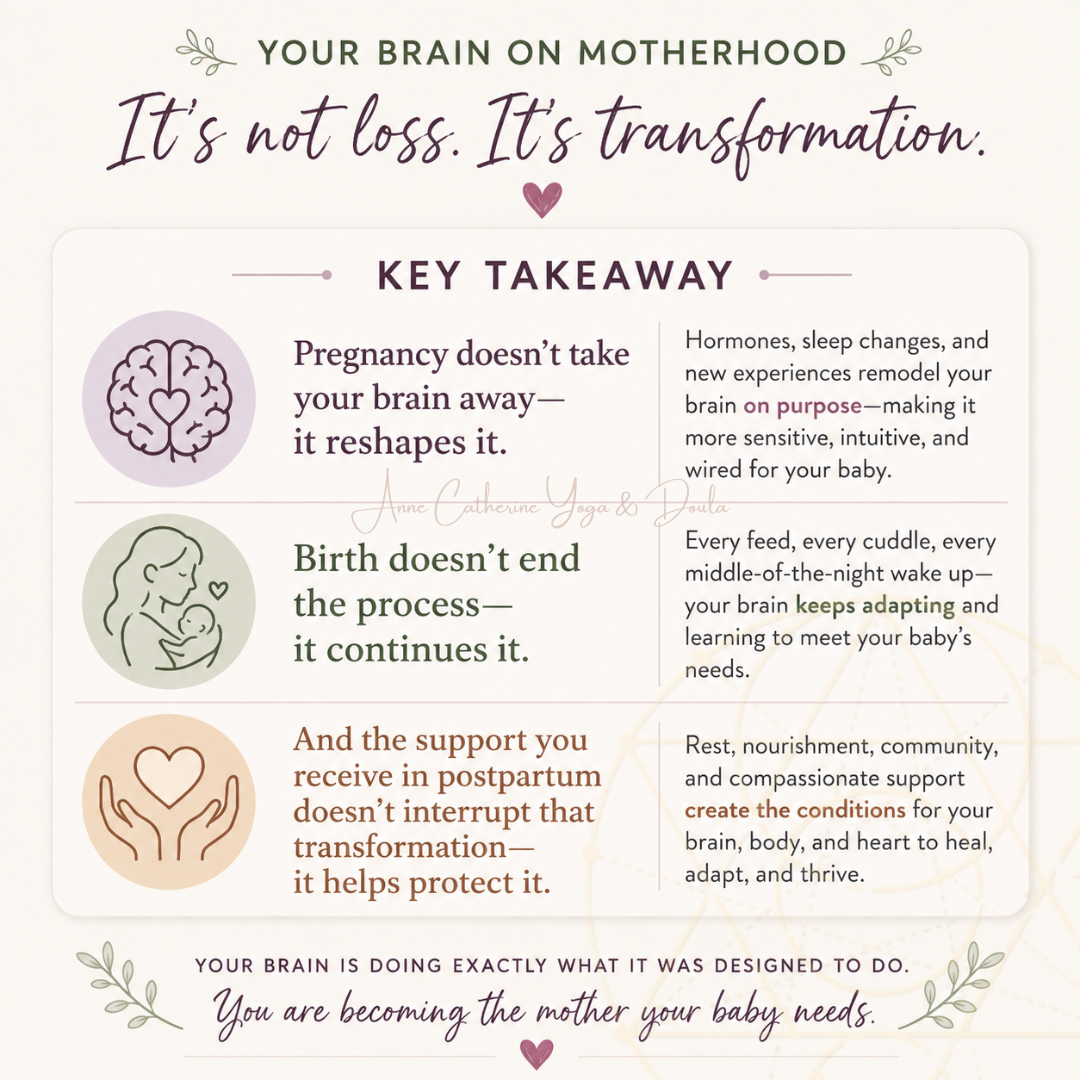
The Parent Brain Is a Remodeling Project
Pregnancy triggers one of the greatest periods of brain remodeling in adult life, alongside adolescence.
Driven by dramatic hormonal shifts, changes in the immune system, sleep, sensory experiences, and caregiving, the brain begins reorganizing itself long before your baby arrives.
Researchers now understand that these changes are purposeful.
Rather than becoming less intelligent, the brain becomes more specialized for parenting:
It learns to prioritize safety.
It becomes more sensitive to your baby's cues.
It strengthens your capacity for empathy, emotional connection, and caregiving.
You aren't losing your mind.
You're growing a parent brain.
Pregnancy Doesn't "Steal Your Brain"
One of the landmark MRI studies comparing women's brains before pregnancy and after birth found reductions in gray matter volume in specific regions of the brain.
At first glance, that sounds alarming.
But researchers now believe these changes are similar to what happens during adolescence through synaptic pruning—the brain trims away unnecessary neural connections so that the pathways that remain become faster, more efficient, and more specialized.
The areas that changed are deeply involved in:
Understanding another person's emotions
Empathy
Reading facial expressions
Social relationships
Recognizing and responding to an infant's needs
Remarkably, the degree of these changes even predicted the strength of maternal attachment after birth.
This isn't brain damage.
It's refinement.
The brain is becoming exquisitely tuned to caring for a baby.
These Changes Last
One of the most remarkable discoveries is that these changes aren't simply temporary.
Research has found many of these structural brain adaptations remain years after birth, suggesting that becoming a parent leaves a lasting biological imprint.
That doesn't mean every change is identical for every person or that the brain stops adapting. The brain remains wonderfully plastic throughout life.
But becoming a mother changes you.
Not only emotionally.
Not only physically.
Neurologically.
Your brain reflects the reality that parenthood is not simply an event.
It is a lifelong relationship.
Your Brain Becomes More Sensitive
Many parents notice they become more emotionally aware after pregnancy.
They hear every little sound.
Wake at the smallest cry.
Feel deeply protective.
Notice things they never paid attention to before.
This isn't weakness.
It's increased vigilance.
The brain's systems for detecting social cues and potential threats become more active because protecting a completely dependent baby requires incredible awareness.
Your nervous system is learning a new job.
Your Memory Isn't Broken
Many women describe forgetting appointments, names, or why they walked into a room.
Research suggests that what many people experience isn't necessarily a damaged memory but a shift in attention.
Think about everything your brain is suddenly tracking:
Fetal movements
Feeding plans
Medical appointments
Nursery preparation
Safety concerns
Household responsibilities
Work
Family
Your own changing body
Your brain is constantly sorting information and asking,
"What matters most right now?"
During pregnancy and postpartum, the answer is often your baby.
Attention is redirected toward caregiving.
Your brain isn't failing.
It's prioritizing.
Sleep Is Part of the Preparation
One of the biggest frustrations many pregnant women experience is disrupted sleep.
You finally get comfortable...
...then you need to use the bathroom.
The baby starts moving.
Your hips ache.
You can't roll over.
Your mind starts making lists.
By the third trimester, many women joke that they're already sleeping like they have a newborn.
While this is certainly exhausting, researchers believe some of these changes may also be adaptive.
Pregnancy gradually shifts your sleep long before your baby arrives.
Rather than going from eight uninterrupted hours to waking every two or three hours overnight, your brain has already begun practicing flexibility.
After birth, responding to your baby's needs becomes one of the strongest drivers of this new sleep pattern.
That doesn't mean chronic sleep deprivation is healthy.
Far from it.
Severe or prolonged sleep loss can affect healing, mood, concentration, and mental health. Parents deserve as much support and rest as possible.
But perhaps we can hold two truths at once.
Sleep disruption is difficult.
And some of it is also part of the remarkable transition into parenthood.
Instead of seeing every nighttime awakening as your body failing you, we might also recognize that your body and brain are preparing you for the life that is about to change forever.
The Brain Doesn't Stop Changing After Birth
Birth is not the finish line.
Every diaper.
Every feeding.
Every middle-of-the-night wake-up.
Every moment you learn what your baby's different cries mean.
Your brain continues adapting through caregiving itself.
These changes don't occur only in mothers.
Fathers, adoptive parents, grandparents, and other primary caregivers also experience changes in the brain through repeated, responsive caregiving.
The common thread isn't pregnancy.
It's caring for another human being.
Why Yoga Is Different
Walking is wonderful.
Strength training has tremendous health benefits.
Swimming, cycling, and resistance exercise all have an important place in lifelong wellness.
But yoga offers something many fitness programs do not intentionally cultivate.
It trains the relationship between the brain, the nervous system, the breath, and the body.
A yoga practice asks you to notice.
To pause.
To regulate your breathing before reacting.
To observe sensations without immediately trying to fix them.
To become aware of your thoughts without believing every one of them.
These are neurological skills as much as physical ones.
As pregnancy reshapes the brain for caregiving, yoga helps strengthen qualities that support this transition: attention, interoception (your awareness of what's happening inside your body), emotional regulation, compassion, and the ability to remain present during uncertainty.
This doesn't mean yoga is "better" than every other form of movement.
Rather, it offers something uniquely complementary.
While many exercise programs primarily train muscles and cardiovascular fitness, yoga intentionally includes the brain and nervous system as part of the practice.
Through breath, mindful movement, meditation, and deep rest, yoga supports not only how your body moves, but how your brain adapts to one of the biggest transitions of your life.
Ancient Wisdom Meets Modern Science
Long before MRI machines could show us changes in the maternal brain, traditional healing systems understood that birth changes a woman in profound ways.
Ayurveda, the traditional system of medicine from India and one of the foundations that has influenced yoga philosophy, views the weeks after birth as one of the most important transitions in a person's life.
This period is often called the Sacred Window—a time not only for physical healing, but for nourishing the nervous system, restoring energy, strengthening digestion, and supporting the emotional transition into motherhood.
From an Ayurvedic perspective, a mother is especially vulnerable after birth.
Not because she is weak.
Because she has undergone an enormous transformation.
Rather than expecting her to return immediately to work, exercise, entertaining, or caring for everyone else, Ayurveda teaches that she should be cared for.
Fed nourishing foods.
Kept warm.
Encouraged to rest.
Surrounded by family and community.
Protected from unnecessary stress.
Modern neuroscience is telling a remarkably similar story.
We now know that the brain is adapting, hormones are shifting, sleep patterns are changing, and new neural pathways are forming as a parent learns to care for their baby.
Ayurveda and neuroscience use different languages.
Yet they arrive at a similar conclusion:
The postpartum period is not something to rush through. It is a time to be supported.
A Mother Needs Mothering, Too
One of my favorite sayings in postpartum care is:
When a baby is born, a mother is born too.
We naturally understand that a newborn cannot thrive without responsive care.
No one expects a baby to simply figure it out alone.
Yet many mothers are expected to do exactly that.
Our culture celebrates independence.
Ayurveda celebrates interdependence.
It recognizes that healing happens best in community.
This is one reason postpartum doulas have existed in different forms across cultures for generations.
A new mother deserves care.
Not because she is incapable.
Because she is doing one of the most important jobs a human being can do.
A Postpartum Doula Supports the Transition—Not Replaces It
One question I hear often is,
"Should I hire someone to take the baby overnight so I can finally get a full night's sleep?"
Like many things in postpartum, the answer isn't one-size-fits-all.
There are certainly times when uninterrupted sleep is exactly what a family needs. Severe sleep deprivation can affect healing, safety, and mental health, and parents deserve support.
But I also think our culture sometimes approaches postpartum from the perspective of trying to recreate life before the baby arrived.
The truth is...
Life has changed.
Your brain has changed.
Your hormones have changed.
Your family has changed.
Rather than trying to return immediately to your old rhythm, there is wisdom in allowing yourself to grow into your new one.
As a postpartum doula, I don't see my role as replacing the parent.
I see my role as supporting the parent while they become one.
Supporting the Biology of Postpartum
If you're breastfeeding, your body works on an elegant feedback system.
Milk production is largely driven by supply and demand.
Frequent milk removal—whether through nursing or pumping—helps establish and maintain milk production, especially in the early weeks.
That means consistently sleeping through nighttime feedings without nursing or pumping may reduce the stimulation that helps regulate milk production for some families.
Instead of asking,
"How can I avoid waking up?"
I prefer a different question:
"How can I receive as much support as possible while honoring what my body and my baby need right now?"
Sometimes that means a partner or postpartum doula brings the baby to you.
Changes the diaper.
Helps with positioning.
Brings you water and a nourishing snack.
Burps and settles the baby afterward.
Washes pump parts.
Allows you to return to bed while they take care of everything else.
Your sleep still matters.
Your healing matters.
But support doesn't have to mean completely stepping out of the caregiving relationship.
Often, it means allowing someone else to carry everything around the feeding, so you can focus on the parts only you can do.
Rest Is Bigger Than Sleep
One of the greatest gifts a postpartum doula can offer isn't simply more sleep.
It's more rest.
Rest might look like:
A warm meal waiting for you.
A clean kitchen.
Folded laundry.
Someone holding the baby while you shower.
Care for older children.
A replenished water bottle and snacks at your feeding station.
Encouragement instead of judgment.
When those daily demands are lifted, your nervous system has more space to heal.
Your energy can be directed toward bonding, feeding, recovering, and learning your baby.
Sometimes that is even more restorative than another hour of sleep while everything else continues to pile up.
A Different Way to Think About Becoming a Mother
Perhaps one of the greatest gifts we can give pregnant and postpartum women is changing the story.
Instead of saying,
"Your memory is getting worse."
What if we said,
"Your brain is reorganizing itself for motherhood."
Instead of seeing every change as something to fight...
...what if we became curious about it?
Pregnancy isn't simply about growing a baby.
It's about growing a mother.
Birth isn't only the arrival of a newborn.
It's the birth of a new identity.
Your body changes.
Your hormones change.
Your priorities change.
Your relationships change.
And yes—
your brain changes.
None of these are mistakes your body is trying to correct.
They are adaptations that help you care for another human being.
Yoga teaches us to meet change with awareness rather than resistance.
Ayurveda teaches us that transformation deserves nourishment, rest, and community.
Modern neuroscience reminds us that your brain is doing exactly what it was designed to do.
Perhaps the goal isn't to get back to who you were before.
Perhaps the invitation is to honor who you are becoming.
Disclaimer
This article is intended for educational purposes only and is not medical advice. Every pregnancy, birth, postpartum experience, and family is unique. Always consult your physician, midwife, lactation consultant, pelvic floor physical therapist, or other qualified healthcare professional regarding concerns about your health or your baby's health.
If you found this article helpful, you are welcome to share it. If you share it with clients, students, or in educational materials, please provide attribution to Anne Catherine Yoga LLC in the spirit of the yogic principles of ahimsa (non-harming) and asteya (non-stealing), honoring both the work and the community it was created to serve.
References
Barba-Müller, E., Craddock, S., Carmona, S., & Hoekzema, E. (2019). Brain plasticity in pregnancy and the postpartum period. Nature Reviews Neuroscience, 20, 591–604.
Glynn, L. M. (2010). Giving birth to a new brain: Hormone exposures of pregnancy influence human memory. Frontiers in Neuroendocrinology, 31(1), 114–123.
Hoekzema, E., et al. (2017). Pregnancy leads to long-lasting changes in human brain structure. Nature Neuroscience, 20(2), 287–296.
Kim, P., et al. (2016). The plasticity of human maternal brain: Longitudinal changes in brain anatomy during the early postpartum period. Behavioral Neuroscience.
Orchard, E. R., et al. (2023). The maternal brain across pregnancy and the postpartum period. Trends in Cognitive Sciences.
This article is for educational purposes only and is not medical advice. Always consult your healthcare provider regarding questions about breastfeeding, nutrition, postpartum recovery, or your individual health. If you found this article helpful, you're welcome to share it. If you're sharing it with clients or students, please credit Anne Catherine Yoga. In the spirit of yoga, we practice both ahimsa (non-harming) and asteya (giving proper attribution to the work of others).
