

Hydration During Pregnancy & Postpartum: Why Water Matters More Than You Think
TL;DR
Hydration needs increase during pregnancy and lactation.
Many people unintentionally become dehydrated during colder months — especially in dry climates like Colorado.
Dehydration may contribute to fatigue, headaches, constipation, dizziness, muscle cramping, and reduced milk supply.
Birth itself is physically demanding and dehydrating, making hydration an important part of postpartum recovery.
Hydration is not only about water intake — minerals, healthy fats, nourishment, and water-rich foods matter too.
Hydration During Pregnancy & Postpartum: Why Water Matters More Than You Think
Have you been feeling extra thirsty recently?
Most people associate dehydration with summer heat, but research suggests dehydration can actually become more common during colder months. Researchers from the University of New Hampshire found that many people drink less water during winter because thirst cues naturally decrease when temperatures drop. At the same time, cold dry air, indoor heating, heavier clothing, and physical exertion can still contribute to fluid loss.¹
And here in Colorado, altitude and dry air can increase hydration demands even further.
If you are pregnant or lactating, hydration becomes especially important.
Your body is working hard:
🤍 Building increased blood volume
🤍 Supporting digestion and circulation
🤍 Regulating body temperature
🤍 Producing amniotic fluid
🤍 Producing milk
🤍 Healing and recovering after birth
That is a tremendous amount of physiological demand.
Why I Sometimes Teach Hydration with Pint Glasses
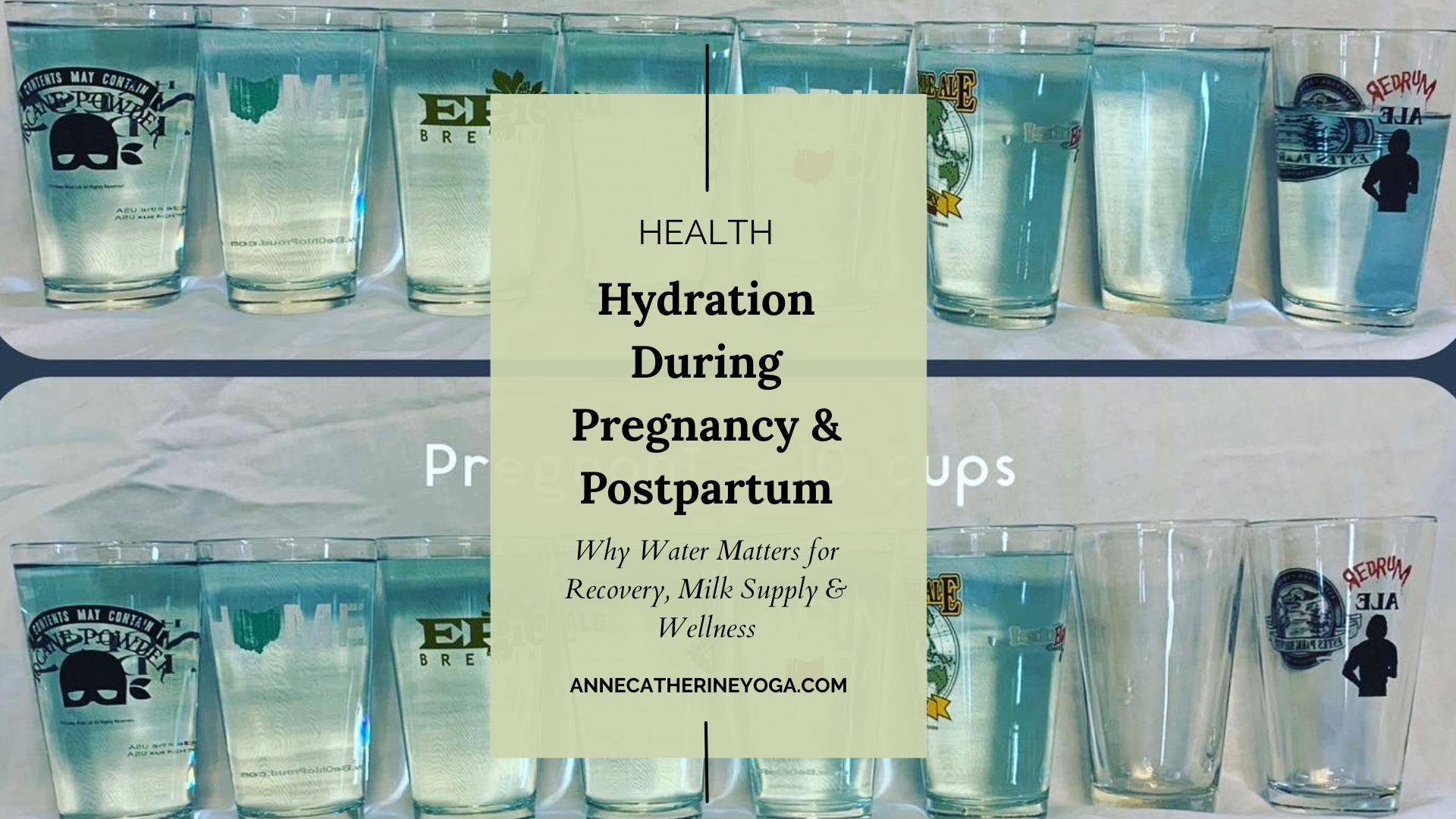
Over the years, I’ve used pint glasses and gallon jugs in class to visually demonstrate hydration needs during pregnancy and postpartum.
Because honestly?
Most people hear:
“Drink more water.”
…but very few people actually visualize what that means across an entire day.
And in Colorado — home to more microbreweries than any other state² — people tend to intuitively understand the volume of a pint glass, even if they do not drink beer themselves.
So I started lining up pint glasses during class.
Not to pressure anyone into perfection.
Not to create rigid rules.
But to help pregnant and postpartum people understand just how much work the body is doing.
During lactation especially, the body is:
🤍 producing milk
🤍 supporting tissue healing
🤍 regulating hormones
🤍 recovering from birth
🤍 functioning on interrupted sleep
🤍 often caring for another human around the clock
That requires nourishment.
And hydration is part of that foundation.
Sometimes seeing the water visually changes everything.
How Much Water Does a Pregnant or Lactating Person Need?
Every body is different, and hydration needs vary depending on:
activity level
climate and altitude
nutrition
illness
exercise
breastfeeding frequency
guidance from your healthcare provider
But general recommendations are often approximately:
9 cups daily for non-pregnant adults
10 cups daily during pregnancy
13 cups daily during lactation³
And honestly?
For many postpartum people — especially while breastfeeding in Colorado’s dry climate — that can feel like a LOT.
Which is exactly why hydration often has to become intentional.
Dehydration Can Feel Like More Than “Thirst”
Especially during postpartum, dehydration can quietly contribute to:
fatigue
headaches
dizziness
constipation
muscle cramping
reduced milk supply
brain fog
feeling physically depleted
And while frequent urination is common toward the end of pregnancy, reducing water intake usually does not solve the problem.
In fact, dehydration itself can contribute to constipation and digestive sluggishness.⁴
Trust me:
You want your digestive system supported before labor, during postpartum recovery, and especially before that first bowel movement after birth.
Birth is physically demanding.
It is sweaty, intense, and deeply dehydrating work.
Hydration is not just about comfort.
It is part of recovery.
Want to learn more about keeping cool while pregnant or with an infant? Check out my article here:
Staying Cool During Pregnancy & Postpartum: What More Mothers Deserve to Know About Heat Safety
Hydration Is More Than Just Water
One thing I often teach students is that hydration is not only about how much water you drink.
Your body also needs:
minerals and electrolytes
healthy fats
nourishing foods
water-rich fruits and vegetables
adequate rest
nervous system support
I often describe the digestive tract like dry soil in a desert.
When the ground becomes too dry, water tends to run off instead of absorbing deeply. Nourishment, healthy fats, minerals, and moist foods help prepare the body to actually utilize the hydration you are taking in.
Think:
🥒 Cucumbers
🍊 Citrus
🍉 Melons
🥣 Soups and broths
🥑 Healthy fats
🥬 Fresh vegetables
🫖 Herbal teas
Small, consistent hydration throughout the day is often more supportive than trying to “catch up” all at once.
Pregnancy & Postpartum Are Seasons of Increased Need
One of the biggest shifts I wish more women understood is this:
Pregnancy and postpartum are not times to expect less from the body while giving it less support.
They are seasons of increased demand.
More nourishment.
More hydration.
More rest.
More support.
Not less.
And postpartum especially is often a time when mothers are caring for everyone else while quietly forgetting their own basic needs.
Water becomes one more thing pushed to the bottom of the list.
But hydration matters.
For recovery.
For digestion.
For milk production.
For energy.
For healing.
For the nervous system.
For feeling more like yourself again.
A Gentle Reminder
Sometimes the basics are actually the deepest forms of care.
Water.
Warm meals.
Rest.
Breath.
Support.
Nourishment.
Slowing down.
So if you’ve been forgetting to drink water lately, this is your gentle reminder:
Fill your cup — literally and figuratively. 💦
Want to feel more supported during pregnancy and motherhood?
Join me for a small group class in Old Town Lafayette! Or Book a Private Session
References
Rosinger AY, et al. Dehydration and seasonal fluid intake patterns. University of New Hampshire / hydration research discussions on cold-weather dehydration.
Brewers Association. Colorado consistently ranks among the top U.S. states for craft breweries and breweries per capita.
National Academies of Sciences, Engineering, and Medicine. Dietary Reference Intakes for Water, Potassium, Sodium, Chloride, and Sulfate. General adequate intake recommendations include approximately 2.3L/day during pregnancy and 3.1L/day during lactation.
American College of Obstetricians and Gynecologists (ACOG). Hydration and digestion guidance during pregnancy and postpartum.
Centers for Disease Control and Prevention (CDC). Maternal Diet and Breastfeeding Recommendations.
This article is for educational purposes only and is not medical advice. Always consult your healthcare provider regarding questions about breastfeeding, nutrition, postpartum recovery, or your individual health. If you found this article helpful, you're welcome to share it. If you're sharing it with clients or students, please credit Anne Catherine Yoga. In the spirit of yoga, we practice both ahimsa (non-harming) and asteya (giving proper attribution to the work of others).
