
Why I Combined Women's Health and Prenatal Yoga (And Why It Isn't a Typical Yoga Class)
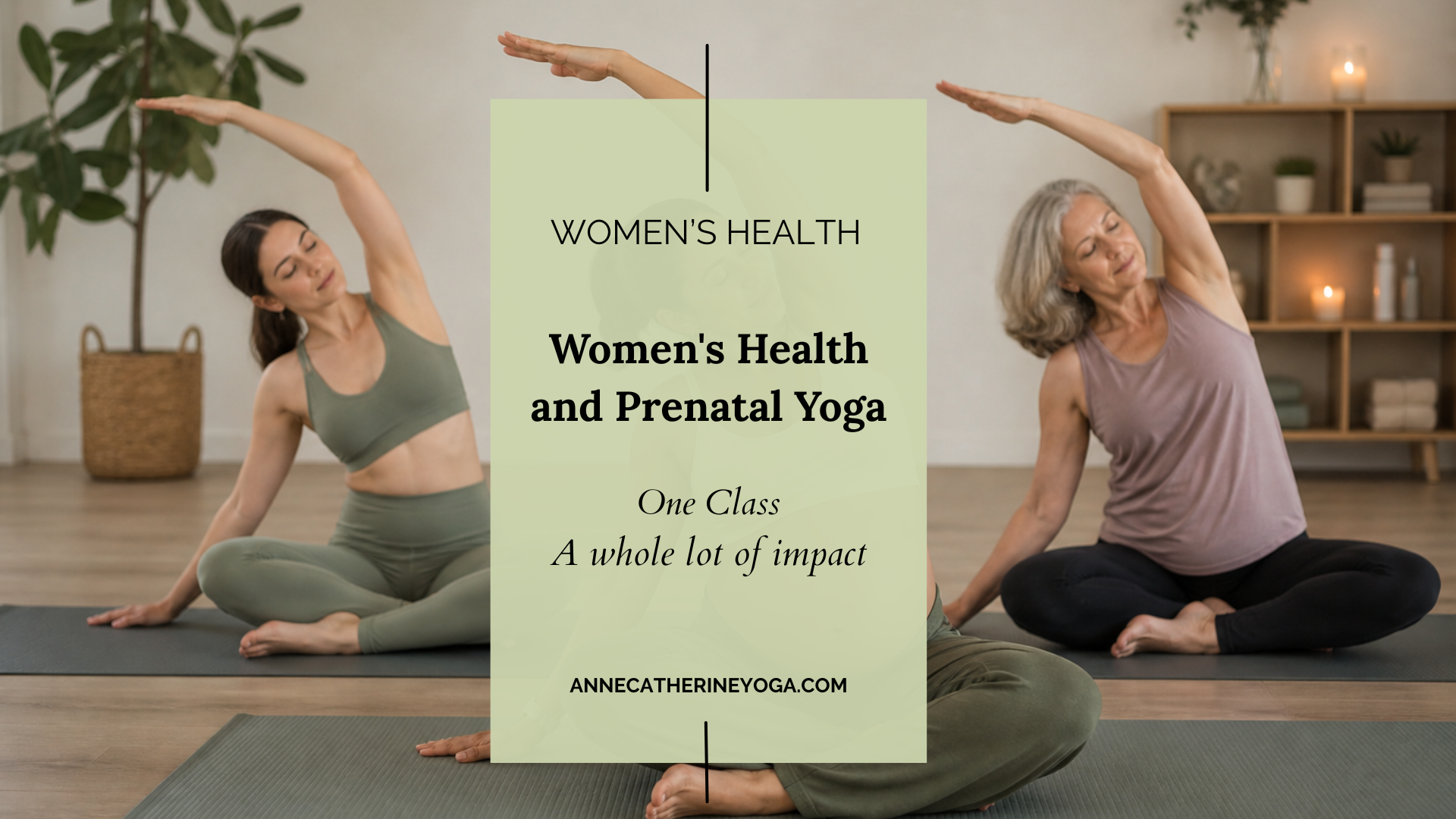
One of the questions I am asked most often is why I combined Women's Health Yoga and Prenatal Yoga into a single class.
It's a fair question.
Most studios separate these offerings completely. Prenatal yoga is for pregnant women. Women's health classes are for everyone else. Postpartum classes are often treated as a short transition period before returning to regular exercise.
But over the years, I began noticing something.
The women coming to my classes were asking many of the same questions, regardless of whether they were pregnant, six months postpartum, preparing for pregnancy, or years beyond having children.
They wanted to understand why their back hurt.
Why they leaked when they sneezed.
Why certain exercises felt good while others seemed to make things worse.
How to strengthen their core.
How to support their pelvic floor.
How to move with more confidence.
How to feel at home in their bodies again.
The truth is that pregnancy is not separate from women's health.
It is women's health.
Pregnancy certainly comes with its own considerations. Breathing changes. Balance changes. The abdominal wall stretches. The pelvic floor adapts. Birth preparation becomes part of the conversation.
But the foundation remains remarkably similar.
Whether a woman is pregnant, postpartum, navigating pelvic floor concerns, entering perimenopause, or simply wanting to move through life with less pain and more confidence, we are still working with the same body systems. We are still exploring how breath influences movement. We are still learning how the core and pelvic floor function together. We are still practicing balance, mobility, strength, stability, and awareness.
The principles don't change.
The application does.
This realization ultimately led me to create two class experiences instead of several separate ones.
The first is Nurture: Postpartum Yoga with Baby.
Anyone who has attended a class with babies knows that it has its own unique rhythm. Babies need to be fed. Diapers need to be changed. Sometimes they sleep through class. Sometimes they don't. New mothers are learning how to care for themselves while simultaneously caring for another human being.
That experience deserves its own dedicated space.
The second is Women's Health + Prenatal Yoga.
This class allows women to focus more deeply on their own movement practice while still receiving individualized support for whatever stage of life they are navigating. Some students are pregnant. Others are preparing for pregnancy. Some are returning after their babies have graduated from mom-and-baby classes. Others join because they want support for pelvic floor concerns, back pain, balance, strength, or simply because they are looking for a more thoughtful approach to movement.
What connects all of these women is not their life stage.
It's their desire to better understand their bodies.
Over the years, I've found that many of the tools I teach during pregnancy continue to serve women for years afterward. Likewise, many women who are not pregnant benefit tremendously from learning about breathing mechanics, pressure management, pelvic floor health, alignment, and functional movement.
Rather than separating women into categories, I prefer to recognize the continuity of our bodies throughout the different stages of life.
Because once we begin understanding how our bodies work, that knowledge serves us whether we are pregnant, postpartum, perimenopausal, or anywhere in between.
As both a yoga teacher and a mother, I have become deeply interested in the intersection of ancient wisdom and modern science. My classes honor yoga's long history while also embracing contemporary understanding of biomechanics, women's health, pregnancy, postpartum recovery, nervous system regulation, and movement science.
I believe women deserve both.
The wisdom of tradition.
And the clarity of evidence-informed movement education.
To understand why this matters, it helps to understand something else:
Women have always been part of yoga's story.
Women Have Always Been Part of Yoga
When people think about women's yoga today, they often assume it is a modern invention.
Perhaps that's because the majority of yoga students in the United States are women. Or perhaps it's because classes like Prenatal Yoga, Postpartum Yoga, and Women's Health Yoga have become increasingly common over the last few decades.
Whatever the reason, there is a widespread assumption that women entered yoga relatively recently.
The historical record tells a different story.
Women have been part of yoga's story for thousands of years.
Some of the earliest philosophical texts in India include women participating in spiritual and philosophical dialogue. Figures such as Maitreyī and Gargī appear in the Upanishads as respected thinkers engaging in profound questions about the nature of reality, consciousness, and human existence.
As yoga traditions continued to evolve, women appeared throughout the historical landscape in many forms. Some were philosophers. Some were ascetics. Some were poets and mystics. Others appear in stories, artwork, oral traditions, and Tantric lineages. The Yoginī traditions, in particular, remind us that women were not simply observers of spiritual practice. They were practitioners, teachers, and embodiments of wisdom in their own right.
Yet if women have always been present, why do their stories seem so difficult to find?
Part of the answer has less to do with yoga and more to do with history itself.
Throughout much of human history, education, literacy, property ownership, and positions of social authority were not equally available to women. Men were far more likely to write books, preserve records, establish institutions, and have their stories documented.
This doesn't mean women weren't practicing. It means fewer people were recording their experiences. As a result, much of women's history lives between the lines.
It lives in artwork depicting female practitioners.
It lives in poetry and oral traditions.
It lives in stories passed through communities.
It lives in the everyday practices of women whose names were never written down.
One of the things I appreciated while studying the history of women in yoga was realizing that we don't have to choose between honoring tradition and acknowledging these gaps.
Both can be true.
Women have always been part of yoga. And women's contributions have often been overlooked. Understanding this changes the way we think about yoga today. Instead of asking whether women belong in yoga, we can begin asking different questions.
How do we better support women in their practice?
How do we understand the unique experiences of pregnancy, birth, postpartum recovery, and menopause?
How do we adapt movement practices to serve the people who are practicing them?
These questions are not separate from yoga.
In many ways, they are a continuation of yoga's long history of observation, inquiry, and self-study. And that brings us to an important reality about the yoga most of us practice today.
While women have always been part of yoga's story, many of the movement systems that shaped modern postural yoga were documented within a very different cultural context than the one we live in today.
Honoring Tradition Without Being Limited By It
One of the things I often hear in yoga circles is that yoga poses were originally designed for adolescent boys. There is some truth to that statement, but it is also an oversimplification of a much larger story. Much of the modern postural yoga practiced today can be traced through teachers such as T. Krishnamacharya, who taught at the Mysore Palace in the early twentieth century. Many of the students he taught were boys and young men associated with the royal household. It is from this historical context that the common statement emerged that modern yoga was developed for young male bodies.
What often gets overlooked is that Krishnamacharya did not invent yoga postures. The practices he taught existed before him, and he himself acknowledged earlier teachers and traditions. His contribution was not the creation of yoga, but rather the preservation, organization, and transmission of teachings during a period when modern postural yoga was taking shape. I have tremendous respect for that work. Without teachers who documented what they learned, much of yoga's history might have been lost.
At the same time, documenting a tradition is not the same thing as telling the whole story of that tradition. Throughout much of history, women had far fewer opportunities to read, write, publish, or hold positions of authority. As a result, women's experiences are often harder to find in historical records. This does not mean women were absent from yoga. In fact, historical sources show women appearing throughout yoga's long history as philosophers, practitioners, ascetics, yoginīs, poets, and spiritual teachers.
This perspective has profoundly influenced the way I teach. Rather than asking whether yoga was created for women or men, I find myself asking a different question: How do we take the wisdom that has been handed down to us and apply it in a way that serves the people practicing today?
To me, that question feels entirely consistent with the spirit of yoga itself. Yoga has never been static. Over thousands of years it has adapted to different cultures, teachers, philosophies, and communities. The yoga practiced today looks very different from the yoga practiced one hundred years ago, which itself looked very different from the yoga practiced hundreds of years before that. Change is not a departure from yoga's history. Change is part of yoga's history.
This is particularly important when we consider women's health. Today we have access to research and clinical understanding that previous generations simply did not have. We know far more about pelvic floor function, pregnancy, postpartum recovery, biomechanics, pain science, and nervous system regulation than was available when many modern yoga systems were first being documented. Ignoring that knowledge in the name of tradition doesn't feel respectful to the women I serve. At the same time, abandoning tradition entirely doesn't feel right either.
Instead, I view my role as standing at the intersection of these two worlds. I am interested in the wisdom of yoga, but I am equally interested in understanding how women move, heal, adapt, and thrive throughout the different stages of life. My goal is not to recreate what happened in a palace one hundred years ago. My goal is to help a pregnant woman move more comfortably, support a new mother recovering from birth, or help a woman understand why her body feels different than it did ten years ago.
In many ways, that is why my classes look different than what some people expect when they hear the word yoga. I am less interested in preserving shapes and more interested in preserving purpose. If a traditional practice continues to serve women today, wonderful. If modern research offers a better understanding of how to support a woman's body, I want to learn from that too. Ultimately, the question guiding my teaching is not, "What did yoga look like in the past?" but rather, "What best serves the women in front of me today?"
What We Actually Do In Class
At this point, you may be wondering what actually happens during a Women's Health + Prenatal Yoga class.
The answer is that it depends on who is in the room.
That may sound unusual, but it is one of the things I love most about teaching this way.
Unlike a large fitness class where everyone is expected to perform the same workout, my classes are intentionally designed to respond to the needs of the students who attend. Some weeks there may be several pregnant women preparing for birth. Other weeks there may be women recovering from injuries, navigating pelvic floor concerns, returning to exercise after years away, or simply looking for a thoughtful way to move their bodies.
Because of that, every class becomes a conversation between the material I have planned and the needs of the women in front of me.
We move, of course. There is yoga. There is strengthening. There is mobility work. There are breathing practices and opportunities for rest. But there is also education woven throughout the experience. Questions are welcomed. Conversations happen. We explore not only what we are doing, but why we are doing it.
A student may ask why a particular movement feels difficult. Another may wonder why her balance has changed during pregnancy. Someone else may be experiencing low back pain, hip discomfort, leaking, pelvic pressure, or uncertainty about returning to exercise after birth. Rather than treating these experiences as distractions from the class, they often become part of the learning.
Over the years, I have found that women are hungry for information about their bodies. Many have spent years attending fitness classes, following online workouts, or receiving advice from well-meaning professionals without ever fully understanding why their bodies respond the way they do. They know something feels off, but they have never been given the tools to connect the dots.
That is one of the primary goals of my classes.
I want women to understand their bodies.
I want them to understand how breathing influences movement, how the core and pelvic floor work together, why certain movement habits may contribute to discomfort, and how small changes in daily life can often have a profound impact on how they feel.
Many students are surprised to discover that some of the most important movement lessons have very little to do with yoga poses. We might spend time discussing how to get out of bed more comfortably, how to carry a child without constantly aggravating one hip, how to sit with better support, or how to create more stability while walking. These are not glamorous topics, but they are often the movements that shape our health far more than any single exercise routine.
This is where Functional Movement becomes such an important part of my teaching. Rather than viewing yoga as something separate from daily life, I see yoga as a way to better understand daily life. Every movement becomes an opportunity to explore how the body functions and how we can support it more effectively.
What I hope students leave with is not simply a good workout or a sense of accomplishment. I hope they leave with a deeper understanding of themselves. I hope they leave with greater confidence in their bodies, a clearer sense of what supports their health, and practical tools they can use long after class is over.
Because ultimately, my goal is not to make women dependent on a teacher.
My goal is to help them become experts in their own bodies.
Why Functional Movement Matters
If you've spent any time exploring my website, attending a class, or speaking with me after class, you've probably heard me talk about Functional Movement.
That's because Functional Movement has fundamentally changed the way I think about yoga, exercise, rehabilitation, and long-term health.
For many years, like most people, I thought of exercise as something separate from daily life. We go to a class, complete a workout, check the box, and then return to our regular activities. The workout is considered the healthy part of the day, while everything else simply happens in between.
What I eventually came to understand is that our bodies don't make that distinction.
The body is responding to movement all day long.
It responds to how we stand while washing dishes. It responds to how we carry our children, sit at our desks, climb stairs, get out of bed, load groceries into the car, and walk through the world. These seemingly ordinary movements happen far more frequently than any exercise routine, which means they often have a greater influence on how our bodies feel over time.
This realization shifted the focus of my teaching.
Rather than asking, "How can I help someone achieve a deeper pose?" I began asking, "How can I help someone move through their life with greater ease, comfort, and resilience?"
That question continues to guide my work today.
When many people think about yoga, they picture flexibility. They imagine touching their toes, doing the splits, or eventually working toward more advanced postures. While flexibility certainly has value, mobility is only one piece of the puzzle. A healthy body also requires strength, balance, coordination, stability, adaptability, and awareness.
I've worked with many women who were incredibly flexible and still experiencing pain. I've also worked with women who considered themselves "tight" yet moved beautifully and functioned well in daily life. The relationship between flexibility and health is often far more complex than we are led to believe.
This is one reason I tend to be less interested in how a pose looks and more interested in how a person is moving.
For example, a deep squat may look impressive, but what matters more to me is whether a woman can comfortably get up and down from the floor to play with her child. A beautiful backbend may earn admiration on social media, but what matters more is whether someone's back feels supported when carrying a baby carrier or spending hours at a desk. A dramatic hip opener may photograph well, but if the person consistently struggles with balance, stability, or discomfort while walking, there may be more important places to focus our attention.
None of this means that advanced poses are bad.
In fact, many advanced postures can be wonderful practices when approached with patience, preparation, and appropriate guidance.
The problem arises when the pursuit of a shape becomes more important than the purpose of the movement.
Social media has amplified this challenge. We are constantly exposed to images of extraordinary flexibility and athleticism. It's easy to begin believing that these shapes represent the goal of yoga. But a photograph can only show us what a pose looks like. It cannot tell us how that body feels, how it got there, or whether the movement is actually serving the practitioner.
For me, the goal of movement has never been to force the body into an ideal shape.
The goal is to create a body that feels capable, adaptable, and supported throughout the realities of everyday life.
This perspective is also why I often encourage students to think beyond symptoms. In my article, Functional Movement vs. Chiropractic: What Most People Are Missing About Pain and Movement, I explore how lasting change often comes from improving movement patterns rather than repeatedly chasing pain after it appears. The same principle applies in yoga. Rather than constantly reacting to discomfort, we can learn to move in ways that support the body before problems arise.
What I love most about Functional Movement is that it places responsibility and possibility back into our own hands.
Instead of viewing the body as something that is broken and needs fixing, we begin viewing it as something that can learn, adapt, and change. We become curious observers of our own habits. We start noticing how we move through the world. We begin asking different questions.
What am I doing all day that might be contributing to this discomfort?
How am I breathing?
How am I standing?
How am I carrying myself?
What small changes could make daily life easier?
These questions may not be as exciting as learning a new yoga pose.
But in my experience, they are often far more transformative.
Because while most of us spend only a few hours each week exercising, we spend every hour of every day moving.
And when we improve the quality of those everyday movements, we often improve the quality of our lives as well.
Of course, understanding movement is only part of the equation.
Many women already know what they "should" be doing. The challenge is learning how to listen closely enough to recognize what their body is actually telling them.
That, perhaps, is where the real practice begins.
Learning to Listen to Your Body
One of the things I have observed over the years is that most women do not need more information.
They already know they should exercise.
They know movement is important.
They know strength matters.
They know sleep, hydration, nutrition, and stress management all influence their health.
The challenge is often something much deeper.
Many women have become disconnected from their own body's signals.
This isn't a personal failing. In many ways, it is the natural consequence of living in a culture that rewards productivity, achievement, and pushing through discomfort.
We are taught to ignore fatigue because there is work to be done. We are encouraged to bounce back after major life events. We are praised for pushing harder, doing more, and persevering through challenges. While resilience is certainly valuable, there is a difference between resilience and disconnection.
Over time, many of us become so accustomed to overriding our body's messages that we stop hearing them altogether.
We stop noticing when we are holding our breath.
We stop recognizing the difference between tension and stability.
We stop paying attention to the subtle signals that tell us we need rest, support, nourishment, or a different approach.
Instead, we look outside ourselves for answers.
We ask experts what to do.
We search for the perfect exercise.
We follow programs, challenges, and routines.
Yet all the while, the body continues trying to communicate.
This is one of the reasons I incorporate somatic movement into my classes.
At its core, somatic movement is not about performing a movement correctly. It is about developing awareness of what is happening inside the body while we move. Rather than focusing exclusively on external alignment or appearance, we begin paying attention to sensation, effort, breath, balance, and coordination.
In practice, this often looks surprisingly simple.
A student may discover she is using far more effort than necessary to hold a posture.
Another may realize she habitually grips her glutes, shoulders, or jaw throughout the day.
Someone else may notice that she stops breathing whenever movement becomes challenging.
These discoveries may seem small, but they can be profoundly important.
Because awareness creates choice.
When we become aware of a pattern, we can begin working with it rather than unconsciously repeating it.
This is particularly important during major life transitions such as pregnancy and postpartum recovery. During these times, the body is changing rapidly. Balance shifts. Breathing mechanics change. Strength and stability fluctuate. A movement strategy that worked six months ago may no longer be the most supportive option.
The same is true throughout the rest of life.
What served us in our twenties may not serve us in our forties.
What served us before children may not serve us afterward.
What served us before an injury may not serve us during recovery.
The body is constantly changing, and our movement practices must be willing to evolve alongside it.
One of the questions I frequently ask students is whether they can distinguish between challenge and strain.
This distinction is not always obvious.
Challenge often feels supportive. It asks us to grow, adapt, and develop new skills. Strain, on the other hand, often feels like we are forcing something that is not ready. The two can sometimes look similar from the outside, but they feel very different from within.
Unfortunately, many fitness environments teach us to ignore this distinction.
We are encouraged to push through.
Push harder.
Go deeper.
Work more.
Do more.
And while there is certainly a place for challenge, there is also wisdom in knowing when a different approach is needed.
Sometimes the body needs strength.
Sometimes it needs mobility.
Sometimes it needs stability.
Sometimes it simply needs rest.
Learning to recognize the difference is a skill.
In many ways, I believe this is one of the most valuable lessons yoga has to offer. Not the ability to achieve a particular pose, but the ability to cultivate a more trusting relationship with ourselves.
Over time, many students tell me they begin noticing changes outside of class. They become more aware of how they breathe when stressed. They notice tension patterns they never realized were present. They begin making different choices throughout the day because they are paying attention in a new way.
That is the kind of transformation that interests me most.
Not becoming better at yoga.
Becoming more connected to your own experience.
Because when we learn to listen to our bodies, we are far more likely to make decisions that support our long-term health.
And once we begin listening, another question naturally emerges:
If women's bodies move through unique transitions throughout life, shouldn't our movement practices reflect that reality as well?
Movement Designed for Women's Bodies
One of the reasons I combined Women's Health and Prenatal Yoga is because women spend much of their lives adapting movement practices that were never specifically designed with their experiences in mind.
This isn't unique to yoga.
Historically, much of what we know about exercise, rehabilitation, and human performance was developed through research conducted primarily on men and then broadly applied to everyone else. While that has begun to change in recent decades, significant gaps still exist in our understanding of how women experience movement, recovery, pain, injury, and exercise throughout the lifespan.
At the same time, women's bodies move through physiological transitions that simply cannot be ignored.
Pregnancy changes the way we breathe, balance, and generate force. Birth changes the abdominal wall, pelvic floor, connective tissues, and nervous system. Breastfeeding influences recovery and hormonal regulation. Perimenopause and menopause introduce another set of changes that affect strength, mobility, tissue health, and overall physical resilience.
Yet many women are still given movement advice that assumes the body remains largely unchanged throughout these experiences.
What I have found through years of teaching is that women are often relieved simply to discover that there is a reason their bodies feel different.
There is a reason a movement that once felt easy now feels challenging.
There is a reason balance changes during pregnancy.
There is a reason breathing patterns shift.
There is a reason certain exercises feel supportive while others leave them feeling worse.
Understanding these changes can be incredibly empowering because it shifts the conversation away from blame and toward awareness.
Instead of asking, "What's wrong with me?" women can begin asking, "What is my body asking of me right now?"
That is a very different question.
It is also one of the reasons I teach alignment differently than many traditional yoga classes.
When most people hear the word alignment, they think about achieving the correct shape in a pose. The assumption is that there is one ideal way for every body to move.
My experience has shown me otherwise.
Bodies are wonderfully diverse.
Some people have naturally mobile hips. Others have more stability. Some have hypermobile joints. Others have years of stiffness from injury, repetitive movement patterns, or simply living in a culture that spends much of its time sitting. Some are pregnant. Some are postpartum. Some are navigating menopause. Some are dealing with chronic pain.
It would be unrealistic to expect all of these bodies to move in exactly the same way.
Rather than asking students to fit themselves into a predetermined shape, I am far more interested in helping them understand how their unique body moves.
What creates support?
What creates unnecessary strain?
What improves balance?
What improves breathing?
What creates a sense of stability and ease?
These questions often lead to far more meaningful outcomes than simply trying to make a pose look a certain way.
This is also where somatic movement plays such an important role in my teaching.
Many movement systems focus primarily on what can be observed from the outside. Somatic movement invites us to pay attention to what is happening on the inside. We become curious about sensation, effort, coordination, and awareness. We begin noticing patterns that may have gone unquestioned for years.
Often, students discover that they have spent much of their lives trying to control their bodies rather than understand them.
The goal of my classes is not to teach women how to control their bodies more effectively.
The goal is to help them develop a relationship with their bodies that is rooted in awareness, trust, and understanding.
Because when we understand our bodies, we can make more informed decisions about how we move, exercise, recover, and care for ourselves.
That understanding becomes particularly valuable during times of transition. Whether a woman is preparing for birth, recovering postpartum, navigating pelvic floor concerns, or adapting to the changes of midlife, the ability to listen, respond, and adapt becomes far more useful than rigidly following a set of rules.
Ultimately, I don't believe women need a separate version of yoga.
I believe women deserve movement education that acknowledges the reality of living in a female body.
And that education extends far beyond the poses themselves.
In fact, one of the things students often tell me is that the most valuable part of class isn't necessarily the movement at all.
It's what they learn about themselves along the way.
Education Is Part of Every Class
One of the comments I hear most often from students is that they've learned more about their bodies in a few months of class than they learned in years of fitness classes.
While that may sound surprising, it isn't entirely unexpected.
Most exercise environments focus on telling people what to do. Very few spend time explaining why.
Students are taught exercises, stretches, and workouts, but rarely given the opportunity to understand the systems that make movement possible. As a result, many women spend years trying to solve problems without fully understanding what is contributing to them in the first place.
This is one of the reasons education is intentionally woven into every class I teach.
My goal is not simply to guide women through movement. My goal is to help them understand what they are experiencing and why.
Sometimes that means discussing how the diaphragm, abdominal wall, and pelvic floor work together to manage pressure throughout the body. Other times it means exploring why certain movements feel more difficult during pregnancy, why balance changes, or why low back pain often has less to do with the back itself than people assume.
We may talk about common pregnancy discomforts and what can be done to support them. We may discuss postpartum recovery and why healing is often more complex than simply waiting six weeks for medical clearance to exercise. We might explore topics such as diastasis recti, prolapse, incontinence, breathing mechanics, foot function, gait patterns, or the relationship between stress and physical tension.
These conversations aren't separate from the movement practice.
They are part of it.
When women understand what is happening in their bodies, movement begins to make more sense. Instead of memorizing exercises, they begin recognizing principles. Instead of relying entirely on external guidance, they develop the ability to make informed decisions for themselves.
I often tell students that I am less interested in teaching them what to think and more interested in teaching them how to think about movement.
Because bodies are constantly changing.
The strategies that feel supportive during pregnancy may look different postpartum. What serves a woman in her twenties may not serve her in her forties or fifties. Injuries happen. Life circumstances change. Stress levels fluctuate. New challenges emerge.
No teacher can anticipate every situation a woman will encounter throughout her life.
But if she understands the principles behind movement, she is far better equipped to navigate those changes with confidence.
This is especially important for women because so many of us have been conditioned to look outside ourselves for answers. We search for the perfect workout, the perfect exercise, the perfect program, or the perfect expert who can tell us exactly what to do.
Yet some of the most meaningful progress occurs when we begin trusting our own observations.
When we understand how breathing affects movement.
When we recognize patterns of tension.
When we notice how certain habits contribute to discomfort.
When we learn to ask better questions.
Education creates that possibility.
It transforms movement from something we perform into something we understand.
And once a woman begins understanding her body, something remarkable often happens.
Fear begins to fade.
Movement becomes less confusing.
Confidence grows.
She stops viewing her body as a problem to solve and starts seeing it as something she can learn from.
That shift alone can be incredibly powerful.
In many ways, it is the foundation of everything I teach.
Because before we can truly support the body, we first need to understand it.
And that understanding is often easier to cultivate when we are surrounded by other women asking the same questions, navigating similar challenges, and learning alongside us.
Community Is Healthcare
For all of the discussion about movement, breathing, core function, and women's health, one of the most valuable parts of class has very little to do with yoga at all.
It's the community.
Throughout most of human history, women moved through major life transitions in the company of other women. Pregnancy, birth, postpartum recovery, parenting, and menopause were not experiences navigated in isolation. Women gathered together. Knowledge was shared. Stories were exchanged. Support was woven into everyday life.
Today, many women find themselves navigating these same transitions very differently.
Pregnant women often spend hours searching the internet for answers to questions they don't feel comfortable asking elsewhere. New mothers may spend entire days caring for a baby without speaking to another adult. Women experiencing pelvic floor concerns, pain, or changes associated with aging frequently assume they are the only ones dealing with those challenges.
As a result, many women carry a sense of isolation that previous generations may not have experienced in quite the same way.
One of the things I have observed over the years is how quickly that isolation begins to soften when women come together in a supportive environment.
A student shares that she is experiencing hip pain and three other women immediately nod in recognition.
Someone asks a question about postpartum recovery and realizes she is not alone in her concerns.
A pregnant student expresses anxiety about birth and receives reassurance from women who have walked that path before.
These moments may seem small, but they matter.
So much of modern health care focuses on identifying problems and finding solutions. While that work is incredibly important, there is another aspect of health that is often overlooked: the simple experience of feeling seen and understood.
Research consistently demonstrates that social connection plays an important role in both physical and mental well-being. We are social beings. We are wired for connection. Yet many women spend years trying to solve challenges entirely on their own.
What I have witnessed in my classes is that healing often happens in community.
Not because the community has all the answers.
Not because everyone shares the same experiences.
But because there is something profoundly reassuring about being in a room with other women who understand.
A woman may arrive thinking she needs help with her core, her pelvic floor, or her back pain.
And often she does.
But what she frequently discovers is that she also needed connection.
She needed a space where she could ask questions without judgment.
She needed a place where she didn't have to explain why pregnancy feels hard, why postpartum recovery takes longer than expected, or why her body feels different than it once did.
She needed to be around other women who understood.
This is one of the reasons community has always been such an important part of my work.
Whether through yoga classes, postpartum support, workshops, or the community groups I facilitate, I believe women deserve spaces where they can learn from one another, support one another, and remember that they are not navigating these experiences alone.
In many ways, the movement simply creates the opportunity for that connection to happen.
Women arrive for yoga.
They stay for the conversations.
They stay for the friendships.
They stay because they realize they have found something increasingly rare: a place where they can show up exactly as they are.
And while the movement is important, it is often those relationships that continue supporting women long after class is over.
Which brings me to perhaps the most important question of all:
Why do I teach this work in the first place?
Why I Teach This Work
People often ask how I became interested in women's health, pregnancy, postpartum recovery, and Functional Movement.
The answer is that it happened gradually.
Like many yoga teachers, I began with a personal practice. What started as an interest in yoga eventually grew into more than twenty-five years of study, practice, and exploration. Over time, I found myself becoming increasingly interested in the question that continues to guide my work today:
How do we help people feel better in their bodies?
That question became even more meaningful when I became a mother.
Pregnancy, birth, and postpartum recovery have a way of changing not only the body, but also the questions we ask about the body. Suddenly, movement is no longer about achieving a pose. It becomes about managing discomfort, preparing for birth, recovering from profound physical changes, carrying babies, navigating sleep deprivation, and finding ways to care for ourselves while caring for others.
Like many women, my own experiences challenged assumptions I once held about health, exercise, and recovery.
I learned firsthand that having information matters.
I learned that support matters.
I learned that healing is rarely as simple or as linear as people often imagine.
Most importantly, I learned how much women benefit when they are given the tools to understand what is happening in their bodies rather than simply being told what to do.
That realization shaped the direction of my professional training.
Over the years, I pursued advanced education in prenatal and postpartum yoga, perinatal corrective exercise, core and pelvic floor function, biomechanics, Functional Movement, somatic practices, and postpartum care. I became an ERYT500 and Registered Prenatal Yoga Teacher, and I have spent more than a decade teaching pregnant and postpartum students. Along the way, I have worked with hundreds of women navigating everything from common pregnancy discomforts to pelvic floor dysfunction, diastasis recti, prolapse, incontinence, birth preparation, postpartum recovery, and the many physical and emotional transitions that accompany motherhood.
Yet despite all of the certifications and continuing education, some of the most important lessons I have learned have come directly from the women I serve.
Every student brings a unique story.
Every body responds differently.
Every pregnancy is different.
Every postpartum recovery is different.
Every stage of life presents its own challenges and opportunities.
Teaching has continually reminded me that there is no single formula that works for everyone.
What women need is not more rigid rules.
What women need is knowledge.
They need support.
They need movement that respects the reality of their lives.
They need someone who can help them make sense of what they are experiencing.
And they need a community where they feel welcome asking questions.
That is the foundation of every class I teach.
Whether a woman comes to class because she is pregnant, recovering postpartum, experiencing pelvic floor symptoms, preparing for birth, or simply wanting a more thoughtful relationship with movement, my goal remains the same.
I want her to leave with a deeper understanding of her body than she had when she arrived.
I want her to feel more confident.
More capable.
More informed.
And more connected to herself.
Because in my experience, that understanding becomes the foundation for everything else.
It influences how we move.
How we care for ourselves.
How we recover.
How we navigate change.
And ultimately, how we experience life in our bodies.
If that sounds like the kind of support you've been looking for, I'd love to welcome you into class.
Ready to Experience It for Yourself?
If you've read this far, you may have noticed that this class is about much more than yoga poses.
It's about understanding your body.
It's about learning how to move in a way that supports you not only during class, but throughout your daily life.
It's about developing strength without unnecessary tension, mobility without sacrificing stability, and confidence without relying on someone else to tell you what your body needs.
Most importantly, it's about recognizing that women's health is not a niche topic.
It is a lifelong journey.
My Women's Health + Prenatal Yoga class welcomes pregnant women in any trimester, women preparing for pregnancy, mothers whose babies have graduated from Mom & Baby classes, and women navigating the many changes that come throughout life.
No prior yoga experience is required.
You do not need to be flexible.
You do not need to be "in shape."
You do not need to know anything about the pelvic floor, biomechanics, or Functional Movement before you arrive.
You simply need a willingness to learn and a curiosity about your own body.
Classes are intentionally kept small to allow time for questions, individualized guidance, and meaningful connection.
Whether your goal is preparing for birth, improving pelvic floor function, reducing discomfort, building strength, returning to movement after postpartum recovery, or simply finding a more sustainable approach to exercise, you will find practical tools that can support you far beyond the yoga mat.
More Than a Yoga Class
When people first hear the words "prenatal yoga" or "women's health yoga," they often assume the class is primarily about exercise.
While movement is certainly part of what we do, it is not the reason these classes exist.
The longer I teach, the more I realize that women are not simply looking for another workout.
They are looking for understanding.
They are looking for guidance that acknowledges the reality of their lives.
They are looking for support that extends beyond fitness trends and one-size-fits-all solutions.
They are looking for spaces where questions are welcomed, where education is prioritized, and where they can feel comfortable showing up exactly as they are.
That is what I hope these classes provide.
A place to move.
A place to learn.
A place to reconnect with your body.
A place to build strength and resilience.
A place to explore the intersection of ancient wisdom and modern understanding.
And perhaps most importantly, a place to remember that you are not alone in whatever season of life you are navigating.
Yoga has always been about far more than physical postures.
At its heart, yoga is a practice of awareness.
A practice of paying attention.
A practice of cultivating a deeper relationship with ourselves.
For me, that is the thread connecting everything in this article.
The history of women in yoga.
The study of Functional Movement.
The exploration of breath, core function, and pelvic health.
The conversations about pregnancy, postpartum recovery, and aging.
The community that forms when women gather together.
All of it points back to the same thing:
Learning to listen.
Learning to understand.
Learning to trust the body we live in.
That journey doesn't end after pregnancy.
It doesn't end after postpartum recovery.
It doesn't end at any particular age.
It continues throughout our lives.
And if there is one thing I hope women take away from my classes, it is this:
Your body is not a problem to solve.
It is a relationship to cultivate.
The more we understand it, the better equipped we are to care for it.
And that understanding has the potential to support us through every stage of life.
This article is for educational purposes only and is not medical advice. Always consult your healthcare provider regarding questions about breastfeeding, nutrition, postpartum recovery, or your individual health. If you found this article helpful, you're welcome to share it. If you're sharing it with clients or students, please credit Anne Catherine Yoga. In the spirit of yoga, we practice both ahimsa (non-harming) and asteya (giving proper attribution to the work of others).
