

Belly Bands, Belts, and Binders, Oh My!
What’s Supportive, What’s Stabilizing, and What’s Just Squeezing You
TL;DR
Pregnancy belly bands help lift and redistribute the weight of a growing uterus and may reduce low back discomfort.
Sacroiliac (SI) belts stabilize the pelvic joints and are supported by research for pelvic girdle pain.
Postpartum binders can offer short-term abdominal support after birth—especially after cesarean—but they do not rebuild core strength.
Traditional belly binding is a culturally rooted postpartum healing practice focused on containment, warmth, and recovery—not waist reduction.
Waist trainers are not medical support devices. They restrict breathing, increase downward pressure, and may contribute to pelvic floor dysfunction.
Always consult your care provider before using compression garments, especially after surgery or if you have prolapse symptoms.
Why You’re Probably Here
If you’re researching belly bands, SI belts, binders, or wraps, it’s likely because something doesn’t feel right.
Maybe your pelvis aches when you walk.
Maybe your pubic bone feels sharp or unstable.
Maybe your low back feels like it’s carrying more than it should.
Maybe postpartum, you feel empty, unsupported, or unlike yourself.
Or maybe you’ve been quietly absorbing the message that something needs to be “fixed.”
That a belt will correct you.
That a binder will tighten you.
That a wrap will get your body back.
During pregnancy, support garments are often marketed as cure-alls. After birth, they’re marketed as shortcuts.
But here’s the softer truth.
Most people don’t go searching for belly support because they’re vain. They go searching because they’re uncomfortable. Because something feels unstable. Because movement has started to hurt.
And movement matters.
Pelvic girdle pain — including symptoms often called symphysis pubis dysfunction (SPD) — reflects altered pelvic mechanics. Research shows that pelvic alignment and load transfer across the sacroiliac joints and pubic symphysis influence comfort, mobility, and functional stability during pregnancy (Vleeming et al., 2008; Mens et al., 2006).
When pelvic pain is ignored, movement often becomes restricted. Gait shortens. One side braces. Muscles guard to protect the joints. In more severe cases, pelvic girdle pain can become debilitating enough to require significant activity modification.
And here is where lived experience meets physiology:
When movement changes, pelvic mechanics change.
When pelvic mechanics change, load transfer changes.
And when load transfer changes, the space through which baby rotates and descends is influenced.
Research and clinical observation support that pelvic alignment and mechanics can influence the course of labor and fetal descent (Vleeming et al., 2008). This does not mean pain guarantees a difficult birth. But it does mean that maintaining pelvic function matters.
Support tools — when used wisely — are not about correcting your body.
They are about helping you keep moving.
They are about reducing strain before discomfort escalates.
They are about maintaining function so your body can continue adapting intelligently.
And here’s the part that often gets missed:
Every reason someone reaches for a belt, band, or binder is also a reason they may need guidance.
If you need a belly band in pregnancy, your core system likely needs coordination support.
If you need an SI belt, your pelvis likely needs functional stability training.
If you’re considering belly binding postpartum, your abdominal wall and pelvic floor need careful reintegration alongside it.
These tools can be helpful — but they work best when paired with breath, alignment, load management, and progressive strengthening.
That’s the work I teach.
Pregnancy belly bands and SI belts are supported by functional pregnancy core training.
Postpartum SI belt use is supported by coordinated abdominal and pelvic floor rehabilitation.
Traditional belly binding should be supervised for safety and integrated alongside intentional core retraining.
And waist trainers?
Those can go in the trash.
Not because your body is wrong — but because your body deserves real support, not aesthetic pressure.
If you’re here because something feels off, unstable, or uncertain — know this:
You don’t need to tighten yourself back into shape.
You need intelligent support.
Sometimes that looks like 1:1 core coordination training.
Sometimes that looks like postpartum doula care — meals prepared, home supported, nervous system soothed.
Sometimes it looks like someone guiding you through safe belly binding and teaching you how to move again with confidence.
Support is not weakness.
It is wisdom.
And it is available to you — whether you are pregnant, one week postpartum, or months into motherhood realizing you still deserve care.
Pregnancy changes the architecture of the body.
The rib cage widens.
The abdominal wall lengthens.
The pelvis becomes more mobile under the influence of relaxin and progesterone.
Your center of gravity shifts forward as the uterus grows up and out.
Pregnancy reorganizes your body from the inside out.
Ligaments soften.
The uterus moves forward and upward.
The spine adapts.
Load transfers differently through the pelvis.
And after birth, the body does not simply “snap back.” It reorganizes again—neurologically, hormonally, structurally. The tissues are healing. The pressure systems are recalibrating. The pelvic floor is integrating new information.
So it makes sense that many birthing people reach for something that feels like support.
But not all “support” is created equal.
In my work with pelvic girdle pain, SPD, core dysfunction, and postpartum recovery, I see confusion around these terms all the time:
Belly band.
Belt.
Binder.
Wrap.
Trainer.
They are not interchangeable.
So the real question is not:
“Should I wear something?”
It’s this:
What kind of support does my body need right now?
Let’s slow this down and walk through each type.
Pregnancy Belly Bands
For weight distribution and ligament support during pregnancy
A pregnancy belly band is typically a soft, wide garment worn under clothing that gently lifts the underside of the abdomen. Its purpose is simple: redistribute weight. It gently lifts from underneath the belly to redistribute uterine weight. Think of a belly band as similar to a compression garment one might wear to support muscles.
As your uterus grows, gravity pulls downward. The round ligaments — which anchor the uterus to the pelvis — stretch and respond to hormonal softening. This is why round ligament pain often feels sharp, pulling, or lightning-like when rolling in bed, standing quickly, or walking.
A belly band can reduce the downward drag on those ligaments.
Research supports the use of maternity support garments for pregnancy-related lumbopelvic pain. A 2015 review in BMC Pregnancy and Childbirth found that support garments may reduce pain and improve functional mobility in pregnant individuals experiencing pelvic girdle pain.¹
The mechanism is straightforward: the band provides external lift to reduce strain on overstretched abdominal tissues and helps counter the forward pull on the spine.
Recommended Products
Belly Bandit® Upsie Belly® Pregnancy Support Band
A structured pregnancy belly band designed to lift and redistribute the weight of the growing uterus, offering adjustable lower back and abdominal support for daily movement and activity. GET IT HERE
Ingrid & Isabel® Bellaband® Seamless Maternity Belly Band
A soft, seamless maternity band designed to extend the life of pre-pregnancy jeans and pants while offering light abdominal coverage and gentle support during pregnancy and early postpartum. GET IT HERE
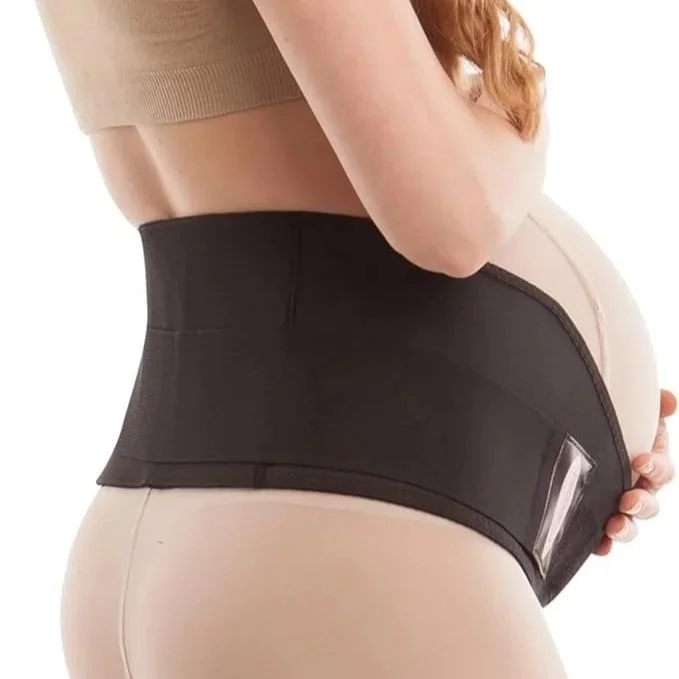
Gabrialla® Elastic Maternity Support Belt
A breathable, structured pregnancy support belt designed to lift the abdomen and provide reinforced lower back support, helping reduce pelvic and lumbar strain during daily movement and extended standing. GET IT HERE
How to Wear It Well
Position it underneath the belly, lifting upward.
It should feel supportive—not compressive.
Wear during longer walks, errands, or prolonged standing.
Remove when resting or lying down.
A belly band is not meant to flatten your abdomen or “hold everything in.” It is a lift, a gentle support, not a squeeze.
If you’re experiencing persistent low back pain, you may also want to read my article on pelvic support and spinal balance in pregnancy in the Learning Library.
When to Wear a Belly Band
A belly band may be helpful when:
You feel heaviness or pulling in the lower belly
You experience round ligament discomfort
You are walking longer distances
You are standing for extended periods
Your low back feels fatigued
You are exercising and want gentle lift
When NOT to Wear It
All day, every day
During rest or lying down
If it increases pelvic pressure
If it restricts breathing
Think of it as situational lift, not permanent compression.
Sacroiliac (SI) Belts
(For pelvic joint stabilization)
This is where precision matters.
A sacroiliac belt is narrow and worn low around the pelvis—across the sacrum and just above the pubic bone - NOT around the waist. It is not a belly band. Think of an SI Belt as a strutured brace one might wear to support a knee joint.
During pregnancy, hormones increase ligament laxity. The sacroiliac joints and pubic symphysis may become unstable, leading to pelvic girdle pain (PGP) or symphysis pubis dysfunction (SPD).
SI belts work by enhancing what’s called force closure—providing external compression that improves joint function by enhancing mechanical stability across the pelvis.
When placed properly—low and snug—they can significantly decrease discomfort with walking, stairs, and single-leg movements.
When to Wear an SI Belt
An SI belt may be helpful when:
Pain is localized near the sacrum or SI joints
You feel instability when walking
Single-leg movements (stairs, putting on pants) cause pain
You experience pubic symphysis discomfort
You have diagnosed pelvic girdle pain
Wear it:
During activity
During walking or prolonged standing
When symptoms are flaring
Remove it:
When lying down
During sleep
When doing gentle floor-based movement
An SI belt is not for lifting the belly.
It is for stabilizing the bones.
How to Use It Intentionally
The belt should sit on bone, not soft tissue.
It should not be worn around the waist.
It is used during activity, not while sleeping.
It should feel stabilizing, not restrictive.
An SI belt is a mechanical stabilizer. It is a tool for joint integrity—not a cosmetic garment.
And like all external supports, it works best when paired with functional movement and core coordination.
Postpartum Binders
For early abdominal recovery after birth
After birth—especially cesarean birth—the abdominal wall has experienced significant strain or surgical incision.
A postpartum binder provides gentle circumferential support in the early days. Research in Journal of Obstetrics and Gynaecology Research (2018) found that abdominal binders after cesarean delivery reduced postoperative pain and improved early mobility.⁴
They may also:
Increase proprioceptive awareness
Reduce incision strain
Support upright posture in early recovery
But here is the nuance.
Binders support tissue. They do not restore neuromuscular coordination.
They do not heal diastasis recti.
They do not rebuild the pelvic floor.
They do not replace rehabilitation.
They are temporary scaffolding.
Used thoughtfully, they can ease the transition. Used aggressively—especially if over-tightened—they can increase intra-abdominal pressure and push downward into a healing pelvic floor.
Gentle compression. Short-term use. Gradual weaning.
Postpartum recovery is not a race.
UpSpring Baby Shrinkx® Postpartum Belly Wrap
An adjustable, multi-panel postpartum binder designed to provide graduated abdominal compression and lower back support during early recovery after vaginal or cesarean birth. GET IT HERE
Momcozy® Postpartum Belly Wrap (C-Section & Vaginal Recovery Support)
An ergonomic postpartum abdominal binder designed to provide adjustable compression and lower back support, helping stabilize the core and support incision comfort during early postpartum recovery. GET IT HERE
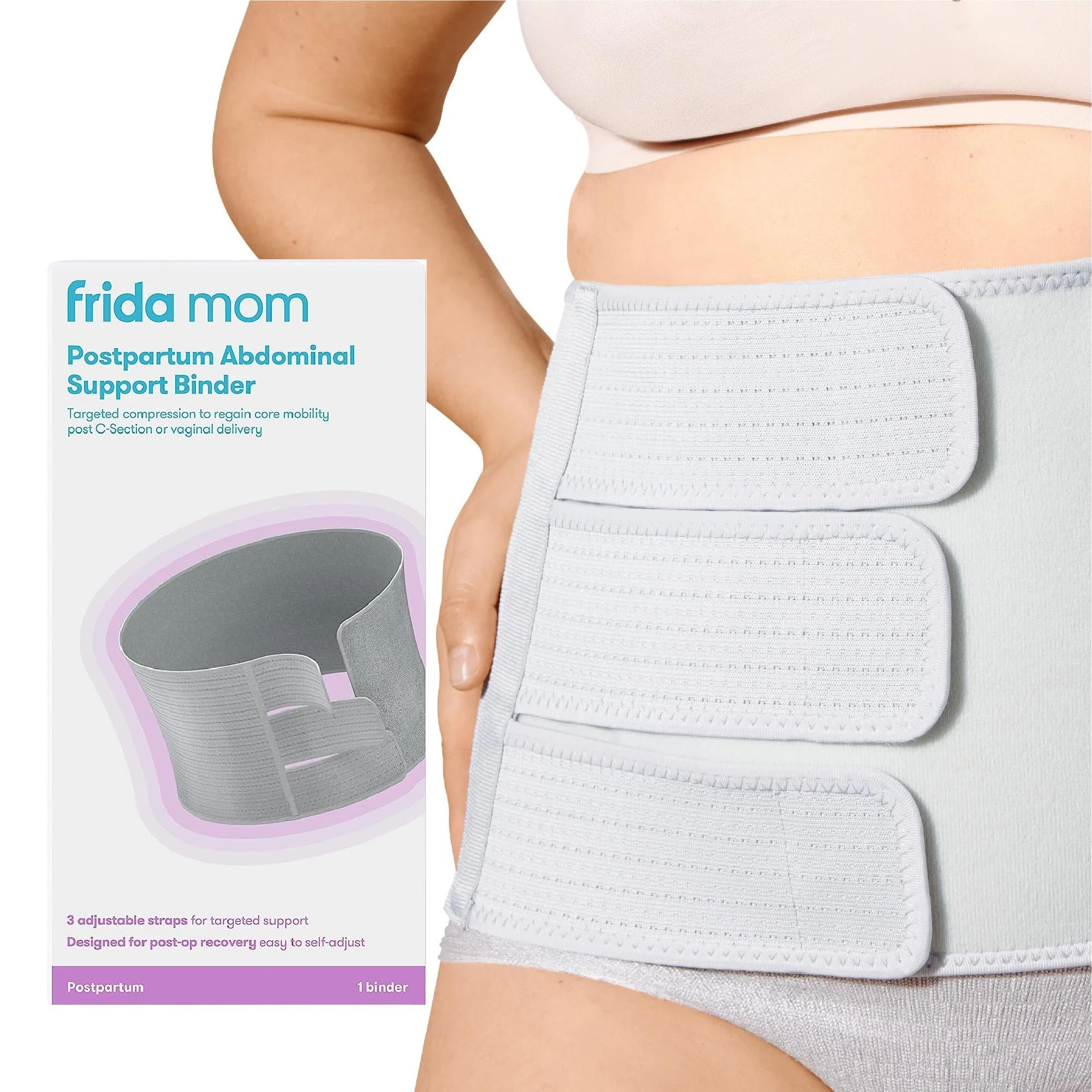
Frida Mom® Belly Binder (9" High Adjustable Postpartum Wrap)
A soft, adjustable postpartum abdominal binder designed to provide gentle compression and lower back support after vaginal or cesarean birth, offering structured yet flexible support during early recovery. GET IT HERE
When to Wear a Postpartum Binder
A binder may be helpful:
In the first 1–3 weeks postpartum
After cesarean birth for incision support
When transitioning from lying to standing
When walking in early recovery
If you feel unsupported in upright posture
Important Considerations
ALWAYS SEEK PROFESSIONAL GUIDANCE if you are new to using a postpartum belly bind.
Do not:
Overtighten
Wear continuously for months
Use as a substitute for core rehabilitation
Gradually reduce use as your body regains coordination.
Remember: binders support tissue — they do not train muscles.
Some postpartum bodies do spontaneously restore function, this is because their body was already functioning in a way which supported this. No device can replace postpartum rehabilitative core training.
Traditional Belly Binding
Containment, warmth, and sacred postpartum closure)
Traditional belly binding is deeply different from modern compression garments.
Long before elastic Velcro binders existed, cultures across the world practiced postpartum wrapping as part of structured healing.
In Malaysia, the Bengkung wrap uses long strips of cloth layered from hips to rib cage and worn for weeks after birth.
In Latin American traditions, the Rebozo is used for wrapping and ceremonial closing rituals.
In Ayurvedic postpartum care, abdominal wrapping supports warmth and Vata regulation during the sacred postpartum window.
These traditions are not about shrinking the waist.
They are about restoring the body after expansion.
Pregnancy stretches the abdomen outward for months. After birth, many birthing people describe a feeling of emptiness, instability, or lack of containment. Traditional binding offers gentle gathering.
Its purpose is to:
Restore warmth after the expansive state of pregnancy
Provide containment when the abdomen feels empty or unstable
Support upright posture
Encourage structured rest
Symbolically “close” the postpartum window
Ground the nervous system after an immense physiological transition
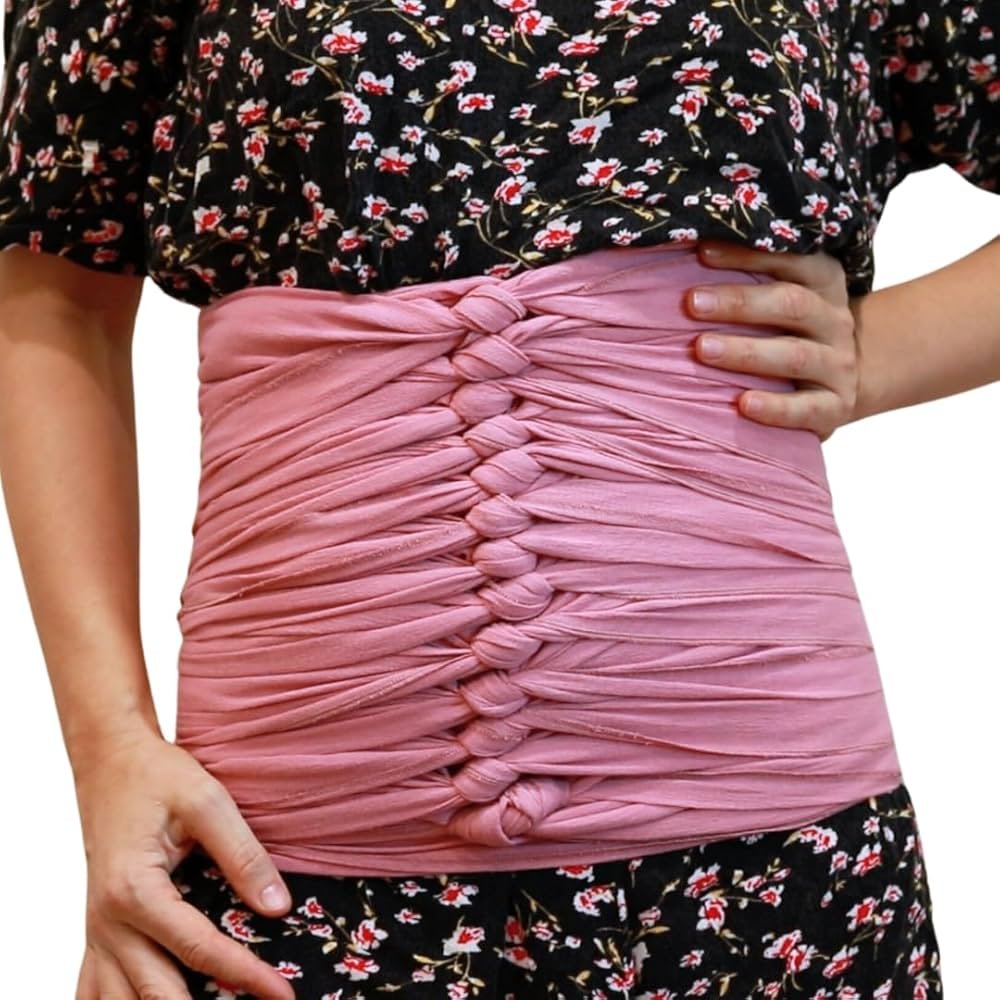
Bengkung
In many traditional systems, binding accompanies oil application (such as Abhyanga), steam therapies, herbal support, nourishing foods, and dedicated rest periods. It exists within a larger philosophy that postpartum is not a quick return to normal — it is a protected phase of recovery.
Traditional binding:
Is adjustable
Allows full diaphragmatic breathing
Honors the body’s timeline
Is part of a broader healing ecosystem
This is fundamentally different from modern waist training.
When to Practice Traditional Belly Binding
Traditional belly binding may be appropriate:
Within the first 40 days postpartum (varies culturally)
After bleeding stabilizes and with provider clearance
As part of a structured rest period
When guided by someone trained in proper technique
When the birthing person desires containment and grounding
It should:
Allow full breathing
Feel supportive, not rigid
Be adjustable as swelling changes
Never create downward pelvic pressure
Traditional binding is relational care.
It is not aesthetic urgency.
It is not about erasing evidence of pregnancy.
It is about honoring the body’s transition.
When done properly, belly binding supports — not suppresses — recovery.
A Note on Guidance and Professional Support
Belly binding is something I offer as part of my postpartum doula care.
This includes traditional wrapping methods such as Bengkung-style binding, as well as education around modern postpartum binders and support garments. Not every body needs the same approach. Not every birth requires the same level of compression. And not every postpartum experience benefits from immediate wrapping.
Together, we assess:
Your birth experience
Tissue healing and incision status (if applicable)
Pelvic floor integrity
Diastasis presentation
Prolapse symptoms
Nervous system regulation
Your personal comfort and preferences
From there, we craft a plan.
Sometimes that means traditional cloth binding.
Sometimes it means a short-term medical binder.
Sometimes it means no compression at all — and instead focusing on breath, positioning, and gradual functional reintegration.
Support should never be copy-and-paste.
It should be individualized, trauma-informed, and grounded in biomechanics.
If you are preparing for postpartum or navigating recovery now, I invite you to learn more about my postpartum doula services and hands-on support. This work is not about tightening your body. It is about supporting your healing.
You deserve containment without restriction.
Strength without pressure.
Care without urgency.
And you do not have to navigate this alone.
Waist Trainers: A Different Category Entirely
Not Support. Not Recovery.
Waist trainers are rigid corset-style garments marketed for slimming or rapid waist reduction.
They are not medical devices.
They are not therapeutic tools.
They are not rehabilitation equipment.
They are ABSOLUTELY CONTRAINDICATED in pregnancy and postpartum.
They are aesthetic garments rooted in beauty culture.
Clinical research and case reports indicate that tight corseting and restrictive shapewear can:
Restrict diaphragmatic breathing
Decrease lung capacity
Increase intra-abdominal pressure
Push pressure downward into the pelvic floor (which can CAUSE pelvic organ prolapse)
Exacerbate reflux
Impair circulation
Increased intra-abdominal pressure is well documented in pelvic floor research as a contributing factor to pelvic organ prolapse and stress urinary incontinence when unmanaged.
A case study published in Annals of Internal Medicine documented gastrointestinal compression and associated symptoms related to restrictive shapewear use.⁵
In the postpartum body — where connective tissue is healing, abdominal fascia is recalibrating, and the pelvic floor is renegotiating load — aggressive compression can be counterproductive.
And here is where I will be clear:
I do not see any health-oriented reason to use a waist trainer.
There is no rehabilitative benefit.
There is no evidence-based pelvic floor support.
There is no physiological advantage.
Waist trainers are designed for aesthetic shaping.
They are not designed for functional restoration.
Pregnancy and postpartum are not cosmetic events. They are physiological transformations.
Recovery deserves better than vanity metrics.
Healing deserves better than pressure to shrink.
WHY am I emphasizing this? Because unfortunately many waist trainers are marketed to postpartum women as “binders”. This underscores the need for guidance from a professinal if you are new to purchasing and using a binder.
The Bigger Picture
External support can absolutely be wise.
But belts and binders are tools — not solutions.
True recovery is not created by compression. It is created by integration.
It is breath that restores pressure systems.
It is functional, developmentally-informed movement that rebuilds stability.
It is pelvic floor coordination that restores continence and resilience.
It is nervous system regulation that allows tissues to heal.
It is rest.
It is nourishment.
It is being supported in ways that allow you to soften instead of brace.
This is the work I teach.
In my sessions and programs, we integrate:
Breath mechanics and intra-abdominal pressure management
Pelvic floor coordination (not just “Kegels”)
Functional core retraining
Developmentally informed movement patterns
Nervous system regulation
Practical postpartum ergonomics
Real-life load management
And when something is outside my scope — prolapse management, complex pelvic pain, surgical complications — I refer to trusted pelvic health physical therapists and medical providers. Collaborative care is not a weakness. It is responsible support.
Because postpartum recovery is not a solo project.
Postpartum Doula Care: Support That Evolves With You
While many people begin postpartum doula support before baby arrives — planning meals, setting up recovery spaces, preparing the home — support can begin at any time.
A week after birth.
A month later.
Three months in when exhaustion finally catches up.
Yes, it looks different depending on when we begin. But that is the beauty of conscious postpartum care — it is designed around your needs, not a rigid timeline.
Sometimes support means:
Thoughtful meal preparation after visitors have stopped bringing food
Light housekeeping so you can rest without guilt
Laundry and practical “mother’s helper” care
Abhyanga (warm oil application) to soothe the nervous system
Gentle belly binding support
Creating feeding and recovery stations
Helping you reorganize your space for functional healing
Sitting with you while you process your birth
Often, we don’t know what we need until we need it.
You might think you’re fine — until the family leaves and the house is quiet.
You might realize what you truly need is not another gadget, but another set of hands.
You might discover that what would change everything is simply someone holding the container while you heal.
It is never too late to receive support.
The best time to hire help is now — the moment you recognize you don’t have to carry it alone.
Conscious postpartum care is not about doing more.
It is about being held while you recover.
And whether that begins before birth or weeks into motherhood, you deserve support that meets you exactly where you are.
Why Professional Postpartum Core Guidance Matters
Postpartum recovery is not just about doing “Kegels.”
And it’s not just about closing a diastasis.
It is about restoring coordination across the entire pressure system — diaphragm, pelvic floor, deep abdominals, spinal stabilizers, and connective tissue.
Research consistently shows that supervised pelvic floor muscle training (PFMT) leads to better outcomes than unsupervised exercise, particularly for urinary incontinence and pelvic floor dysfunction (Dumoulin et al., 2018; Bø et al., 2015). Studies also show that many women are unable to correctly contract their pelvic floor without instruction — and some inadvertently bear down instead of lifting (Bump et al., 1991).
Accuracy matters.
But core rehabilitation is more than isolated contraction.
Diastasis recti — the separation of the rectus abdominis along the linea alba — is influenced by load management, intra-abdominal pressure, connective tissue behavior, and movement strategy.
Research on postpartum abdominal rehabilitation suggests:
Not all abdominal exercises affect inter-recti distance equally (Mota et al., 2015).
Exercise selection, load, and technique influence tension across the linea alba.
There is no universal “one best exercise” for diastasis recovery (Gluppe et al., 2018).
What this tells us is important:
Core recovery is not a one-size-fits-all program.
It is progressive.
It is pressure-sensitive.
It is highly individual.
In rehabilitation science more broadly, supervised motor learning improves adherence, movement quality, and outcomes. Feedback enhances neuromuscular coordination. Progressive loading reduces reinjury risk.
This applies directly to postpartum core recovery.
Because what we are rebuilding is not just strength.
We are rebuilding:
Timing
Breath coordination
Load transfer
Tissue resilience
Nervous system safety
This is why individualized postpartum core training matters.
Not because women are incapable of doing it alone — but because the postpartum body is complex, adaptive, and worthy of intelligent guidance.
And when something falls outside my scope — significant prolapse, complex pelvic pain, surgical complications — I collaborate and refer to pelvic health physical therapists and medical providers. Responsible care includes knowing when to partner.
Postpartum recovery deserves precision.
Closing: Support Is Not Compression — It’s Integration
Belly bands.
Belts.
Binders.
Wraps.
They are tools.
And tools can be wise.
But none of them replace coordination. None of them replace breath. None of them replace progressive, intelligent loading of the core system. None of them replace being seen and supported during one of the most transformative windows of your life.
If you are reaching for a support garment, your body is asking for something.
Stability.
Containment.
Relief.
Confidence.
Reassurance.
Those are not cosmetic desires.
They are functional needs.
In pregnancy, belly bands and SI belts can help reduce strain and allow you to keep moving — but they work best alongside intentional core training and functional movement that restores balanced load transfer across the pelvis.
Postpartum, SI belts and binders may provide temporary support — but true recovery requires breath coordination, abdominal reintegration, and pelvic floor timing.
Traditional belly binding can be beautiful and deeply supportive — when practiced safely and integrated alongside core rehabilitation.
And waist trainers? They are not support. They are cultural noise.
If you want real support — the kind that respects biomechanics, nervous system regulation, and your lived experience — that is the work I offer.
Through 1:1 perinatal core training, we rebuild your pressure system intelligently and progressively.
Through postpartum doula care, we support your whole environment — meals prepared, home steadied, oil application offered, belly binding guided, laundry folded, space held — so that your body can actually recover.
Most people begin postpartum doula care before baby arrives. But you can begin any time. A week after birth. A month later. When the visitors leave. When the fatigue sets in. When you realize you don’t have to do this alone.
The best time to receive support is when you recognize you need it.
You are not something to tighten.
You are something to support.
And whether that support begins with a belt, a breath, a training session, or someone standing beside you in your kitchen while soup simmers — it can begin now.
References
Kalus SM et al. (2015). Maternity support garments for lumbopelvic pain during pregnancy. BMC Pregnancy and Childbirth.
Mens JMA et al. (2006). The effect of a pelvic belt on pelvic stability. Clinical Biomechanics.
Vleeming A et al. (2008). European guidelines for pelvic girdle pain. Spine.
Cheifetz O et al. (2018). The effect of abdominal binders following cesarean delivery. Journal of Obstetrics and Gynaecology Research.
Takeda et al. (2017). Restrictive shapewear associated gastrointestinal symptoms. Annals of Internal Medicine.
Dumoulin C et al. (2018). Pelvic floor muscle training versus no treatment for urinary incontinence. Cochrane Database of Systematic Reviews.
Bø K et al. (2015). Evidence for pelvic floor muscle training. British Journal of Sports Medicine.
Bump RC et al. (1991). Assessment of Kegel performance after instruction. American Journal of Obstetrics and Gynecology.
Mota P et al. (2015). Effect of abdominal exercises on inter-recti distance. Physical Therapy.
Gluppe SL et al. (2018). Postpartum exercise and diastasis recti. British Journal of Sports Medicine.
ACOG Committee Opinion No. 804 (2020). Physical Activity and Exercise During Pregnancy and the Postpartum Period.
This article is for educational purposes only and is not medical advice. Always consult your healthcare provider regarding questions about breastfeeding, nutrition, postpartum recovery, or your individual health. If you found this article helpful, you're welcome to share it. If you're sharing it with clients or students, please credit Anne Catherine Yoga. In the spirit of yoga, we practice both ahimsa (non-harming) and asteya (giving proper attribution to the work of others).
